
Liquid-Cooled AI Halls Multiply Leak Points, So Operators Are Moving Sensing Beyond Threshold Alarms
Facility and production engineers planning AI-capable halls are meeting an old industrial trade-off dressed in new clothing: the cooling architecture that makes extreme rack density possible also installs the largest population of failure points. Cooling malfunction remains the second-leading contributor to data center outages, and the economics beneath it have inverted — one unplanned stop now generally destroys more value than the components it damages. That reframes the specification question from "can we alarm when liquid appears?" to "can we find liquid at its origin, soon enough to protect the compute schedule?" Answering it takes detection that identifies fluid chemistry, localizes the event, and can still be pushed into halls already in service, because much of the installed cooling base was laid out before Nvidia GB200-class inference hardware reset the pace.
What a Shutdown and a Shutout Really Cost
Operations teams sit between two failure modes. Pull a loop offline over what turns out to be an innocuous flow or pressure wiggle, and capacity is forfeited for nothing. Let a genuine escaping volume run its course, and the hall learns what a shutout means. Neither outcome deletes cost. A noisy, alarm-prone scheme merely relocates it — from hardware repair invoices to lost compute revenue — and for a GB200-class cluster the revenue line is usually the heavier one.
A more useful engineering goal dissolves the dilemma instead of pricing it. Discriminating detection removes the need to either trip on anomalies or lift thresholds until real events slip past. Judging what the fluid actually is matters as much as how little of it can be sensed: a device that tells coolant apart from condensation sounds an alarm only when sounding one is the correct call.
 Figure 1: Real-time sensing applied early exposes leaks in AI halls while a minor anomaly is still minor, instead of after it matures into an infrastructure event.
Joint Counts Are Growing Faster Than the Odds Are Falling
Part of the difficulty is inherited. Leak-detection scopes were mostly written when a leak meant a drip pan sitting under a computer room air handler, while AI infrastructure has since raced toward liquid cooling as rack densities climbed. A GB200-based NVL72-class rack carries between 125 and 270 fluid connection pairs, and next-generation GB300-based racks double that figure. Excellent reliability at a single joint therefore still compounds into a meaningful event count across a fleet: the industry is deploying leak-prone interfaces faster than it is lowering the odds that any given area releases fluid.
Four Legacy Methods and the Structural Limit Each One Carries
High-density liquid cooling exposes the constraints embedded in conventional approaches. Conductive cable needs fluid to travel to it, to pool deeply enough to register, and to conduct current; vendor documentation is blunt that such cable will not detect DI water or a DI water/glycol blend, chemistries that together comprise the recommended coolants for the newest rack designs. Point and optical devices require a human being to have correctly predicted where a leak would occur. Flow and pressure monitoring can catch gross failures, but an early-stage leak stays concealed inside normal operating variation.
Common Misconceptions Worth Retiring
- "Any liquid will trigger the alarm." Not with conductive cable and DI-based coolants; the chemistry assumption fails first.
- "Sensitivity alone is the specification." Sensitivity without chemistry discrimination and localization still leaves operators guessing.
- "Raising thresholds ends false alarms." It converts one cost into another while real weeps pass unnoticed.
- "Detection is a new-build line item." Commissioned halls are where retrofit pressure bites hardest.
Slow Weeps Are a Question of Size and Time
Small, slow leaks carry disproportionate consequences and must be identified quickly to prevent damage or unnecessary downtime. Consider a weep at a manifold seal: microliters an hour, evaporating nearly as fast as it appears, able to persist for days without ever pooling deep enough to trip a conventional sensor. The Open Compute Project's leak detection white paper states this explicitly — slow leaks often leave only residue behind, and a detection rope will not catch them. The deeper problem is not damaged hardware; it is the limit late detection places on an operator's options.
Caught early, an event lets a single rack be isolated on the center's own schedule. Found late, an entire cluster can go offline at the worst possible moment, with foregone compute revenue exceeding hardware loss. That gap is precisely why the target window is measured in seconds or minutes rather than hours or days.
Printed, Conformal, Wide-Area: A Change of Geometry
Rather than relying solely on individual detection points, industry thought leaders have devised a flexible, conformal, wide-area method built on low-cost printed electronic technology. An electrochemical sensing stack printed onto a thin, flexible film delivers continuous two-dimensional coverage instead of hits at discrete spots, and wireless mesh nodes paired with the transducer feed the BMS and DCIM systems a facility already runs. Reported performance sits at under five microliters — about a tenth of a droplet — detected in under one second across every coolant chemistry in data center use: water, glycols, natural and synthetic oils, and dielectric cooling fluids.
For retrofits and dimensionally constrained installations the practical payoff is that predicting where a leak might occur stops mattering: a conformal film fits the space in place of fabricating a complex network of manifolds whose only job is to route leaks to a sensor.
| Design question | Legacy point-based schemes | Wide-area printed sensing |
|---|---|---|
| Coverage shape | Discrete points with gaps between them | Continuous two-dimensional surfaces |
| What the fluid must do | Travel to the sensor and pool deep enough to register | Detected wherever the film is laid |
| Chemistry fit | Conductive cable blind to DI water and DI water/glycol | Water, glycols, oils and dielectric fluids |
| Siting burden | Human prediction of the leak location | Far less dependence on exact placement |
| Growing the loop | New plumbing toward sensors | Battery-operated wireless nodes, no new utilities |
Eight Advantages Operators Are Betting On
- Surface coverage: flexible films follow floors, trays, piping routes, rack areas, manifolds and other irregular geometries, closing unsensed gaps for blanket coverage.
- Earlier detection: continuous coverage spots small quantities of coolant before they accumulate into a significant pool or reach equipment.
- Localization: distributed sensing identifies where along the sensing area a leak is occurring, shortening response.
- Adaptability: sensing routed around racks, bends, connectors and mechanical piping suits rapidly evolving AI environments.
- High-density protection: modern AI racks hold substantial liquid-cooling hardware and high-value electronics, and wider coverage watches more of the potential leak path.
- Rapid retrofits: a battery-operated, wireless, distributed architecture deploys as racks, cooling loops or infrastructure are added, or as "vintage" sites move from air to liquid cooling, with no new hardware or utilities required.
- Siting tolerance: continuous sensing spans a much larger area than a single point sensor, easing dependence on exact placement.
- Controls integration: leak location and alarm information correlate with CDU data such as coolant pressure and flow, enabling faster isolation and root-cause investigation.
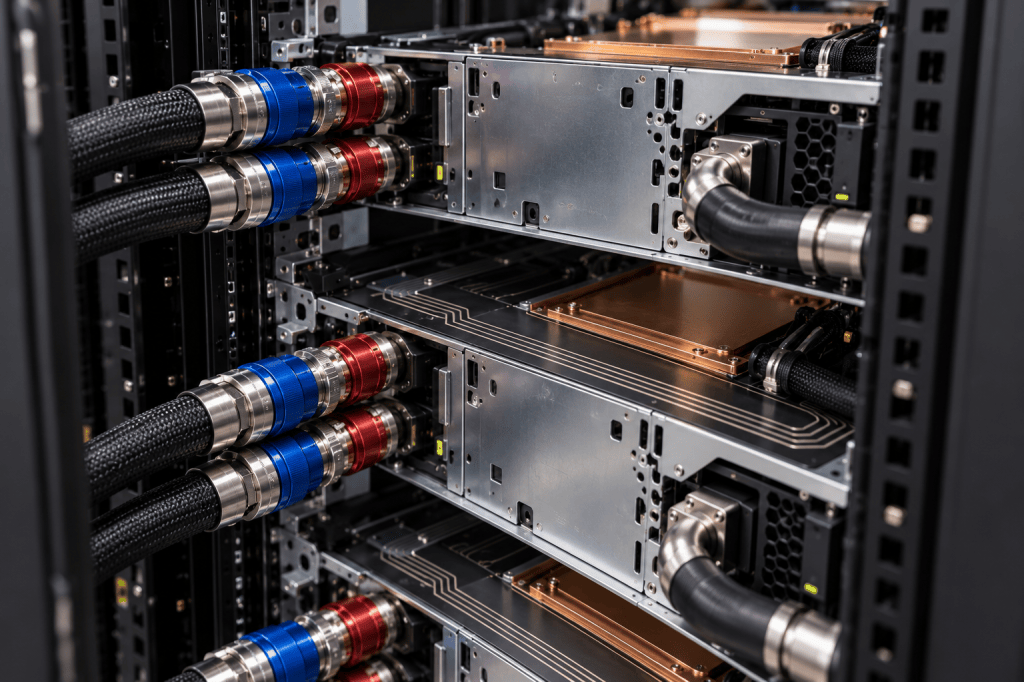 Figure 2: Flexible sensing integrated into high-density server environments can reveal small coolant leaks near critical components and support early intervention.
Field Databases Put Numbers on the Exposure
Process-safety QRA databases matter here because they publish rigorous per-fitting-year leak frequencies distilled from decades of field data, among them IOGP RADD 434-01 and Norway's PLOFAM. A flanged joint runs from 5.0E-6 to 1.3E-5 incidence per joint-year for small leaks, while a small-bore instrument connection sits at 2.0E-4. Applying those rates to a GB200 rack's 252 individual couplings plus cold plates, manifolds and hoses yields 0.38% per rack-year at base case, inside a range of 0.14% to 6.00%. For a GB300 with more than 500 couplings, the figure becomes 0.76%, and couplings alone account for 80–85% of rack leak risk.
Design Guidance and Insurers Pull in the Same Direction
Leak detection is moving from afterthought to part of the design. Nvidia's GB200 and GB300 documentation already defines three distinct detection tiers, and OCP guidance spans from cold plates through the CDUs — unsurprising when GB300 rack systems feature 544 fluid couplings across 18 compute trays, a substantial number of candidate origins for a leak. Insurers will likely drive the functionality further: Allianz's 2026 claims analysis already ranks water damage as the most frequent cause of reported data center claims, and underwriters are beginning to write liquid-cooling risk controls into new policies.
ML Supports the Response but Does Not Touch the Fluid
Direct sensing and machine learning coupled with flow- or pressure-based monitoring are expected to converge rather than compete. ML can dynamically adjust sampling rates or sensitivity at a node when conditions warrant, but it operates several steps removed from the event itself and will not replace physical detection of a small weep that has just appeared.
Action Guidance for Production and Facility Managers
- Count the joints first. Inventory fluid connection pairs by rack class — 125 to 270 per GB200-based NVL72-class rack and double that for GB300-based systems — before sizing any detection scheme.
- Name the coolant. Check chemistry against the sensing technology; conductive cable cannot see DI water or a DI water/glycol mixture.
- Define the response window. Set detection targets in seconds or minutes, since discovery in hours or days removes the option of isolating one rack on schedule.
- Plan coverage as an area, not a point. Where cable, point, optical, flow or pressure methods leave structural gaps, wide-area conformal film closes them.
- Retrofit ahead of rebuild. Wireless, battery-operated distributed sensing can be deployed in commissioned halls and "vintage" air-cooled conversions without new utilities.
- Feed the existing controls. Route alarm and location data into BMS / DCIM and correlate it with CDU pressure and flow to speed isolation and root-cause work.
- Track the requirement setters. Watch Nvidia tier guidance, OCP scope from cold plates through CDUs, and insurer clauses such as those reflected in the Allianz 2026 analysis.
Frequently Asked Questions
Why is legacy conductive cable inadequate for AI racks?
Because three conditions must all be met: fluid must travel to the cable, pool deeply enough to register, and conduct electricity. Vendor documentation is explicit that such cables will not detect DI water or a DI water/glycol mixture — the coolants recommended for the newest rack designs.
What is the real cost of detecting a leak late?
Late discovery constrains options. Early detection allows a single rack to be isolated on the center's schedule; late detection can take an entire cluster offline at the worst time, and the foregone compute revenue typically exceeds hardware loss.
Can a hall already in service be protected without new infrastructure?
That is the design intent of wide-area printed sensing: a thin, flexible film plus wireless mesh nodes and battery-operated distributed architecture deploys as racks and cooling loops are added, or as "vintage" sites convert from air to liquid cooling, with no new hardware or utilities required.
Does machine learning make physical sensors obsolete?
No. The two converge. ML can adjust sampling rates or node sensitivity when conditions warrant, but it sits several steps removed from the event and will not detect a small weep that has just appeared.
The Takeaway for Industrial Readers
Read as an operations program rather than a component purchase, the shift is straightforward: quantify the joint population, verify coolant compatibility, insist on localization, and treat commissioned halls as buildable targets instead of fixed liabilities. Concerns over leak detection keep rising as AI data centers adopt higher rack densities and more extensive liquid-cooling installations, and San Diego-based Serinity is spearheading the move to decentralized detection over wide areas — printed-electronics sensing installations that provide a more timely and complete picture of the presence of liquid in a protected area.