
WorldIndustrialWeekly General: Dry-Zone Floor Specifications for Traction, Sanitation and Total Cost
Bureau of Labor Statistics data places falls, slips and trips as the second-leading cause of fatal workplace injuries. For dry food, baking, dairy and pharmaceutical operations, that statistic explains why flooring decisions carry weight beyond comfort or appearance: each surface choice can change exposure. For decades, plants have been pressed to choose between traction that creates crevices and smooth floors that reduce grip, especially where moisture control is critical.
The Core Trade-off in Dry Processing Environments
The usual way to raise traction is to texture a floor with grooves and crevices. Those features can provide grip underfoot, yet they can also retain fine powders, flour and organic dust. In wet areas, routine water cleaning may remove that debris. In dry processing facilities, however, water washdowns are restricted or eliminated to keep moisture from introducing Listeria, Salmonella and other pathogens. That restriction changes the trade-off: powder left inside traction features can create harborage points that do not satisfy the Food Safety Modernization Act (FSMA) or U.S. Department of Agriculture (USDA) sanitation standards.
What Plants Need From a Dry-Zone Floor
A dry-zone floor must do more than satisfy one metric. It needs to reduce slip risk while remaining compatible with dry sanitation practices. That means the surface should provide grip without deep powder traps, support documented traction testing under contamination, allow debris to be removed predictably, and close the perimeter in a way that prevents residue from accumulating in unsealed gaps. The result is a purchasing brief rather than a simple finish selection.
A Sweepable Stainless Approach for Dry Areas
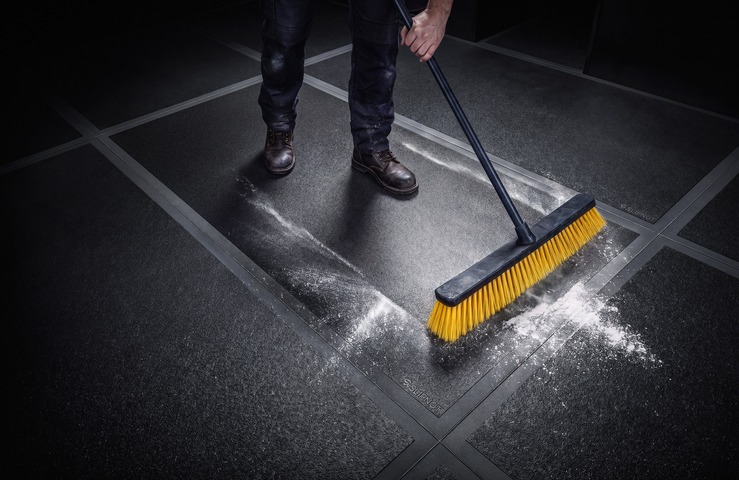
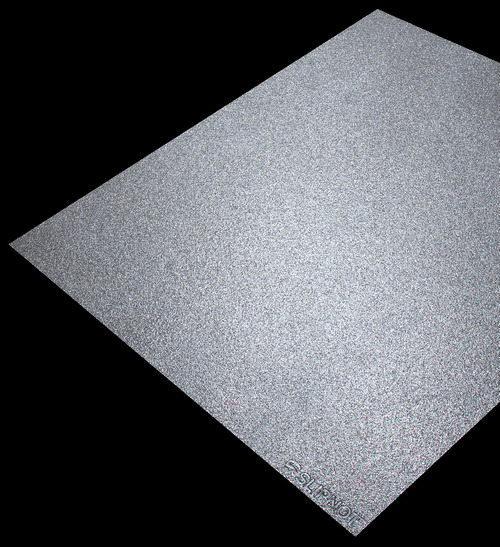
One emerging answer is a class of sweepable, high-traction stainless steel surfaces intended for dry processing facilities. Instead of cutting deep grooves, these surfaces fill the microscopic valleys of a high-friction texture while leaving millions of tool-steel-hard traction peaks exposed. The objective is to keep the peaks that generate slip resistance, while reducing the spaces that collect powder. A standard push broom can clear the surface in a single pass without sacrificing grip.
Common Misconceptions: Older Workarounds Rarely Solve Both Problems
Before engineered sweepable surfaces were available, plants tried familiar fixes with mixed results. Several recurring misconceptions can make those fixes look more complete than they are.
- Coatings and tapes: tapes, paints and grit coatings wear down quickly under foot and cart traffic, requiring constant reapplication.
- Beaded plate assumptions: dotted metal plates are often installed on the assumption that a broom can sweep debris out from around welded beads. In practice, fine powder still packs in at the base of each dot.
- Weld durability: the welded beads can loosen or snap off under heavy rolling-cart loads, exposing smooth, slippery metal.
- Diamond plate as a cleanability shortcut: diamond plate depends on a raised metal pattern rather than true surface grip, so once it is coated in dust or a light film of oil, it loses much of its grip.
- Marketing language: surfaces described as easy to clean still require evidence that debris is removed under dry processing conditions.
Each option addresses durability or cleanability, but rarely both. The practical lesson is that the visible texture alone does not prove that powder will clear.
Comparison of Legacy Options
| Option | Observed limitation | Useful verification request |
|---|---|---|
| Tapes, paints and grit coatings | They wear down quickly under foot and cart traffic, requiring constant reapplication. | Ask for lifespan, reapplication intervals and maintenance cost data. |
| Dotted metal plates | Fine powder still packs in at the base of each dot, and welded beads can loosen or snap off under heavy rolling-cart loads, exposing smooth, slippery metal. | Require before-and-after cleanability data, not unverified claims. |
| Diamond plate | It depends on a raised metal pattern rather than true surface grip, so once it is coated in dust or a light film of oil, it loses much of its grip. | Require dry DCOF measured with fine-powder contamination. |
Data Citation and Specification Gate: Evaluate DCOF Under Contaminated Conditions
This mismatch is often a measurement problem as much as a materials problem. When selecting flooring, plant leaders should request Dynamic Coefficient of Friction (DCOF) data rather than relying only on older static tests. DCOF measures grip while someone is actively walking, making it more relevant to slip events than a reading taken while standing still.
For a dry processing zone, the decisive result is dry DCOF measured with fine powder worked into the surface. A clean, dust-free reading alone is not enough for these environments.
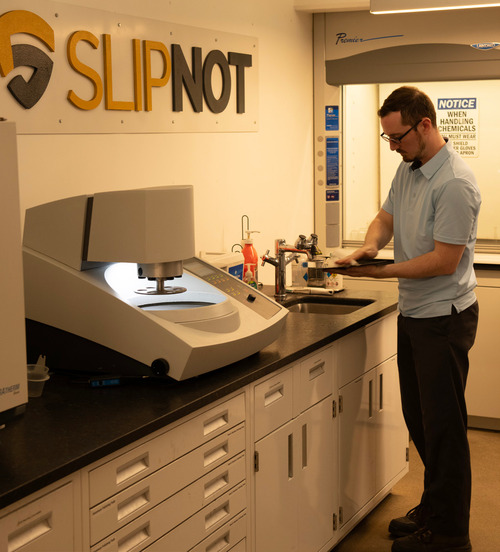
Under American National Standards Institute (ANSI) A326.3 protocols, a dry DCOF above 0.80 on a clean surface indicates excellent baseline traction, while a reading above 0.60 with contamination present is considered reliable in real-world use. In-house testing of one such engineered surface recorded a clean dry DCOF of 0.97 and 0.71 with flour worked into the surface. Both numbers clear the corresponding benchmarks.
Any flooring specification should require documented DCOF data under contaminated conditions, not just a clean-sample rating.
Case Reference: Sanitation and Sweepability Need the Same Verification
Sanitation compliance adds another layer. Under FSMA and USDA rules, metal flooring in food processing areas generally needs to be fully seam-welded along every edge to prevent gaps where moisture, food residue and bacteria collect.
Some manufacturers pre-mask a surface's perimeter edges before installation so field crews can complete a full-seam weld without burning or delaminating the finish. Before approving any installation, plant leaders should confirm how the perimeter will be sealed and whether the finish can tolerate that kind of weld.
Surface sweepability deserves the same verification as traction and compliance. Comparative lab testing of five common industrial floor surfaces used UV tracer powder to visualize particle retention before and after sweeping, alongside dry DCOF measurement. The results found that dotted metal and diamond-pattern surfaces marketed as easy to clean still retained significant debris after repeated passes, while the sweepable engineered surface came clean in far fewer passes.
Plant leaders evaluating any flooring option should ask suppliers for before-and-after cleanability data rather than relying on unverified claims.
Total Cost of Ownership: Price Per Square Foot Is Not Enough
Price per square foot is only the first line in the evaluation. According to the Liberty Mutual Workplace Safety Index, overexertion injuries tied to slipping and catching one's balance cost employers more than $13 billion a year in direct workers' compensation costs.
Sanitation labor can affect the same business case. In-house modeling on this type of surface found that a three-line facility running two dry cleanings a day, saving 20 minutes per line per cleaning, can recover more than 730 hours of production availability annually. That availability recovery supports Overall Equipment Effectiveness.
Specifying the right surface during a new build or expansion is almost always cheaper than retrofitting an active line later. That makes flooring a decision worth making early, rather than reactively, after an incident or a failed audit.
Action Recommendations for Facility and Engineering Teams
- Start with the dry-use conditions, not a general slip-resistance claim.
- Require dry DCOF results under fine-powder contamination, using American National Standards Institute (ANSI) A326.3 context for the numbers.
- Request sweepability evidence that shows particle retention before and after cleaning.
- Verify seam-welding details before installation approval.
- Model total cost over five years, including cleaning time, injury-related compensation cost and production availability.
FAQ: Four Questions Before Signing Off
Before signing off on a flooring solution for a dry processing zone, plant leaders should be able to answer four questions.
- What is the dry DCOF - both clean and with fine-powder contamination - and how was it tested?
- How is debris actually removed, with data to back up the claim?
- How will the perimeter be sealed to meet seam-welding requirements?
- What does the total cost look like over five years, not just on the installation invoice?
These checks are not paperwork. They convert a floor finish into an auditable decision. If the data shows traction under contamination, if the cleaning evidence shows debris removal, if the perimeter can be fully seam-welded, and if the long-term cost includes production availability and injury-related compensation cost, the plant can move forward with a measured basis.
A surface that can answer only one or two of these checks leaves dry processing teams in an old compromise: safety on one side, sanitation on the other. When the evidence covers traction under contamination, sweepability, perimeter sealing and multi-year cost, the choice becomes a measurable specification rather than a concession.