
Reading the Full Document Stack Before Groundbreaking: CrunchAI Risk Intelligence Inside Trimble's Document Crunch
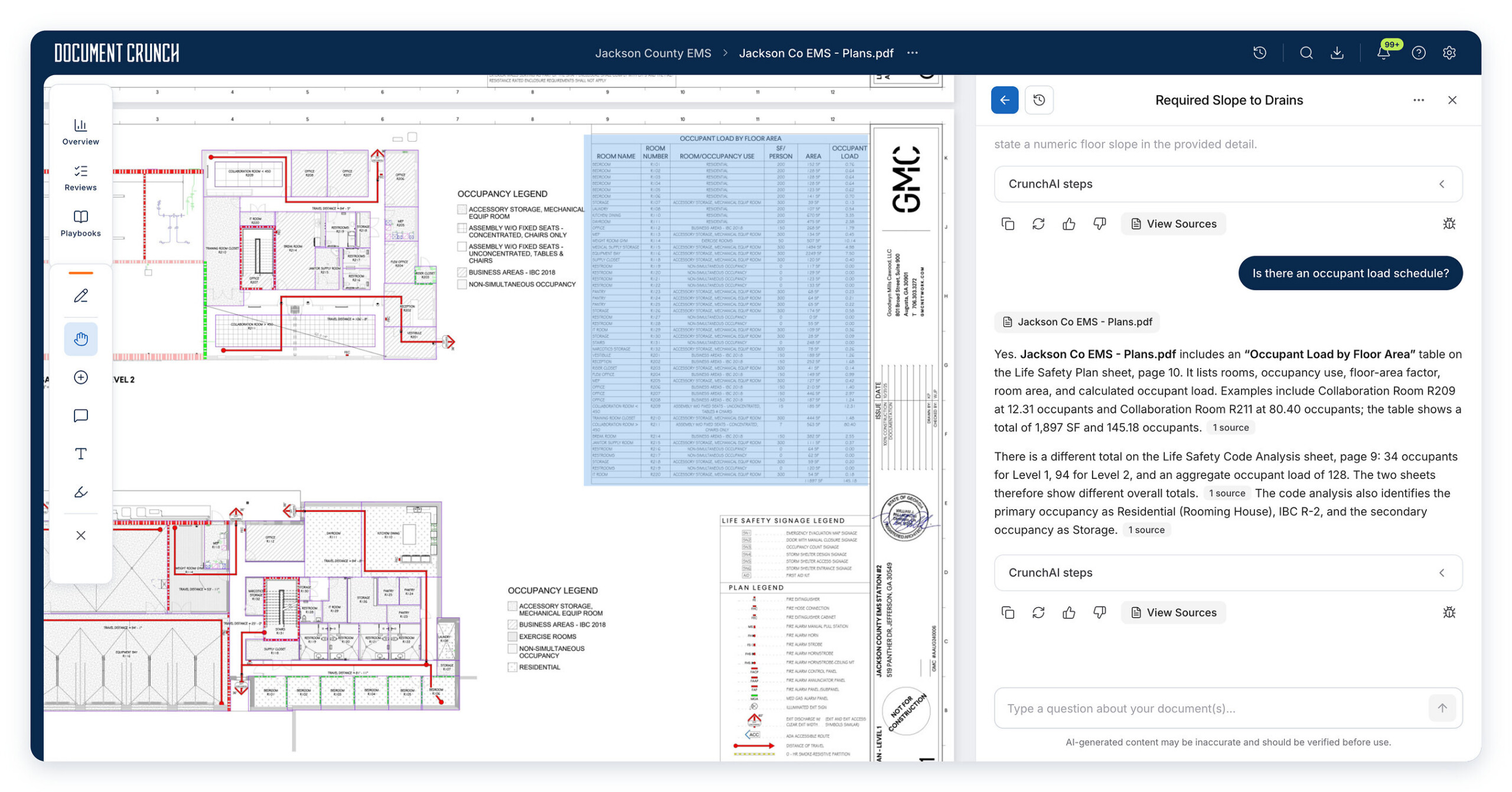
Problems on industrial builds rarely begin in the field. They begin on paper — in the seam between a drawing note, a contract clause and a specification section that nobody ever read side by side. Document Crunch, a Trimble company, has introduced project-level risk intelligence capabilities aimed squarely at that seam: contractors can examine construction drawings together with contracts, specifications and other project documents, and query the complete set before work starts. Powered by CrunchAI, the capability brings scope gaps, conflicting requirements and potential risks into view while a project team can still act on them.
For plant owners, production managers and engineering leads reading this from the industrial side, the signal is straightforward: document review is being treated as an operating discipline rather than an administrative chore.
From filing cabinet to queryable project dataset
The launch centers on search and query across whole document sets. Instead of a reviewer opening sheets one at a time, teams working with Document Crunch can search and interrogate drawings, contracts and specifications as a single body of project information, then look for scope gaps, conflicting requirements and potential risks. The comparison happens before construction begins: CrunchAI places drawings against contracts and specifications so discrepancies surface in the preconstruction window rather than after award.
The technical premise is equally plain. General-purpose AI models may struggle to process large, text-heavy drawing sheets and to connect requirements scattered across multiple project documents. When that parsing is weak, conflicts and gaps among drawings, contracts and specifications stay invisible — which is precisely how scope disputes are born.
Generic model limits versus construction-workflow design
| Dimension | General-purpose AI handling | CrunchAI approach as described |
|---|---|---|
| Drawing sheets | May struggle with large, text-heavy sheets | Extracts and indexes text from drawing sets, including notes, allowances and scope-related language spread across multiple sheets |
| Cross-document linkage | Requirements across multiple documents are hard to connect | Drawings, contracts and specifications can be queried together through a chat interface |
| Verifying an answer | Difficult to trace back to the source | Responses are verified through citations linked to source documents |
| Response generation | Generic processing pipeline | Pre- and post-processing methods with agentic optimization, applied to construction workflows |
| Team handling of findings | Individual, ad hoc queries | Shared project environment with security and collaboration features: discuss issues, track review activities, monitor how risks are addressed |
| Follow-through | Notes left in a chat history | Findings can move into standardized reviews, with follow-up and resolution tasks assigned |
Case snapshot: Document Crunch inside Trimble construction workflows
Because Document Crunch operates within existing workflows as a Trimble company, the review capability is not a standalone tool teams must bolt onto their process. Inside those workflows, teams review drawings alongside contracts, specifications and other project documents. The situation the launch illustrates is a familiar one in industrial delivery: a bid or project package where scope language is distributed across many sheets and many documents, and where the same information has to be read consistently by estimators, engineers, project controls and the trade partners who will ultimately build to it.
What the preconstruction pass is designed to catch
By analyzing drawing sets in the context of other project documents, Document Crunch enables teams to:
- Review bid sets. Verify sheet indexes, spot missing sheets or specification sections, and flag discipline-level discrepancies during preconstruction.
- Identify document conflicts. Compare drawings with contracts and specifications to find conflicting requirements, scope gaps and unclear responsibilities.
- Standardize reviews. Apply consistent company checks to drawing sets and related project documents across teams, rather than leaving review depth to individual habit.
- Address issues before construction. Resolve requirements and scope questions before contract award, reducing the number of unresolved issues carried into project execution.
Key facts at a glance
| Item | Detail as stated in the launch |
|---|---|
| Vendor relationship | Document Crunch is a Trimble company |
| Underlying technology | CrunchAI |
| Capability introduced | Project-level risk intelligence for construction document review |
| Document types in scope | Construction drawings, contracts, specifications and other project documents |
| Target problems | Scope gaps, conflicting requirements, potential risks |
| Timing of review | Before construction begins; scope questions resolved before contract award |
| Verification method | Citations linked to source documents |
| Availability | Construction drawings review capability available to all users within existing Document Crunch workflows |
Common misconceptions
- "The model will simply read our drawings." Reading a text-heavy sheet is not the same as indexing notes, allowances and scope-related language distributed across many sheets — the gap general-purpose models are described as struggling with.
- "A good answer is enough." The described workflow pairs responses with citations linked to source documents; an untraceable answer is not usable evidence in a scope conversation.
- "Finding the conflict finishes the job." The process continues past detection: findings move into standardized reviews, follow-up and resolution tasks are assigned, and the shared project environment tracks how risks are addressed.
- "This is one reviewer's shortcut." Standardizing reviews applies consistent company checks across teams; the value lies in uniform depth, not individual speed.
- "Risk review belongs only to design." The stated scope covers bid sets and preconstruction checks, with requirements and scope questions resolved before contract award — the operational window immediately preceding execution.
Action recommendations for project and operations teams
- Treat the drawing set as data: confirm sheet indexes, specification sections and discipline-level content are complete before any review pass, so missing sheets can actually be spotted.
- Query across documents rather than within them — run drawings against contracts and specifications together, since the named failure modes sit between documents.
- Demand the evidence trail: use citation-linked responses to verify each finding against its source before the point enters a clarification or negotiation.
- Convert individual checks into standardized company reviews so every team applies the same checks to drawing sets and related project documents.
- Close findings before award: assign follow-up and resolution tasks, track review activity and monitor how each risk is addressed instead of carrying unresolved scope questions into execution.
Availability
The construction drawings review capability is available to all Document Crunch users and operates within existing Document Crunch workflows, so teams can review drawings alongside contracts, specifications and other project documents without adopting a separate process.
FAQ
What does the new risk intelligence capability actually do?
It lets contractors examine construction drawings together with contracts, specifications and other project documents. Using CrunchAI, project teams search and query complete document sets to identify scope gaps, conflicting requirements and potential risks before construction begins.
Why is this different from asking a general AI model about a drawing?
General-purpose models may struggle to process large, text-heavy drawing sheets and to connect requirements across multiple project documents. CrunchAI is built for construction workflows: it extracts and indexes text from drawing sets — notes, allowances and scope-related language spread across sheets — and answers queries through a chat interface, with verification via citations linked to source documents.
Can teams act on findings inside the same environment?
Yes. The shared project environment includes security and collaboration features so teams can discuss identified issues, track review activities and monitor how risks are addressed. Findings can also be moved into standardized reviews with follow-up and resolution tasks assigned.
Which review use cases are named in the launch?
Bid set review (verifying sheet indexes, spotting missing sheets or specification sections, flagging discipline-level discrepancies), document conflict identification, standardized company reviews, and resolution of requirements and scope questions before contract award.
Who can use it now?
Document Crunch's construction drawings review capability is available to all users within existing workflows.
Drawing a line under it: the shift worth noting for industrial readers is not that AI has entered construction paperwork, but that risk review is becoming a queryable, citable and standardized step in the project process — one that Document Crunch, as a Trimble company, now positions at the front of the workflow, before scope questions reach the execution phase.