
Case File: How two-thirds of China's September New-Car Sales Went Electric — and What Industrial Operators Can Reuse
A WorldIndustrialWeekly operations case review, written by Michael Torres for Industrial Weekly.
Walk a Chinese auto supply park the month after the sales charts were published and the strangest sight is not the electric cars. It is the quiet ones: engine lines running two shifts instead of three, an injector supplier renegotiating payment terms, a sales hall that once displayed petrol models now given over to charging bays and delivery lounges. Read as a case file rather than a headline, last month's Chinese passenger-car data documents something every manufacturing, procurement and channel team will eventually face: a demand pool that shrinks while its composition flips, leaving the asset base sized for a market that has already gone.
The case at a glance: record share, contracting volume
The record itself is real. According to the China Passenger Car Association (CPCA), new-energy vehicles — the Chinese category covering battery-electric vehicles (BEVs) and plug-in hybrids (PHEVs) — took 67% of domestic new-car sales, which means two out of every three cars sold in the month of September carried a plug. What the summary tables do not shout is that NEV volumes fell as well; they simply fell more slowly than the market around them.
Three arithmetic points from the CPCA series, as compiled in the original Carbon Brief analysis, hold the paradox together:
- Sales of fuel-only cars were down 31% year-on-year across the first nine months of 2026, with plug-in hybrid sales down 26%, whereas battery EV sales were only down 4%.
- This September, passenger-car retail across all categories contracted, with overall sales volumes falling 28% year-on-year.
- Chinese carmakers' exports of NEVs more than doubled in 2026 to date / in September from a year earlier.
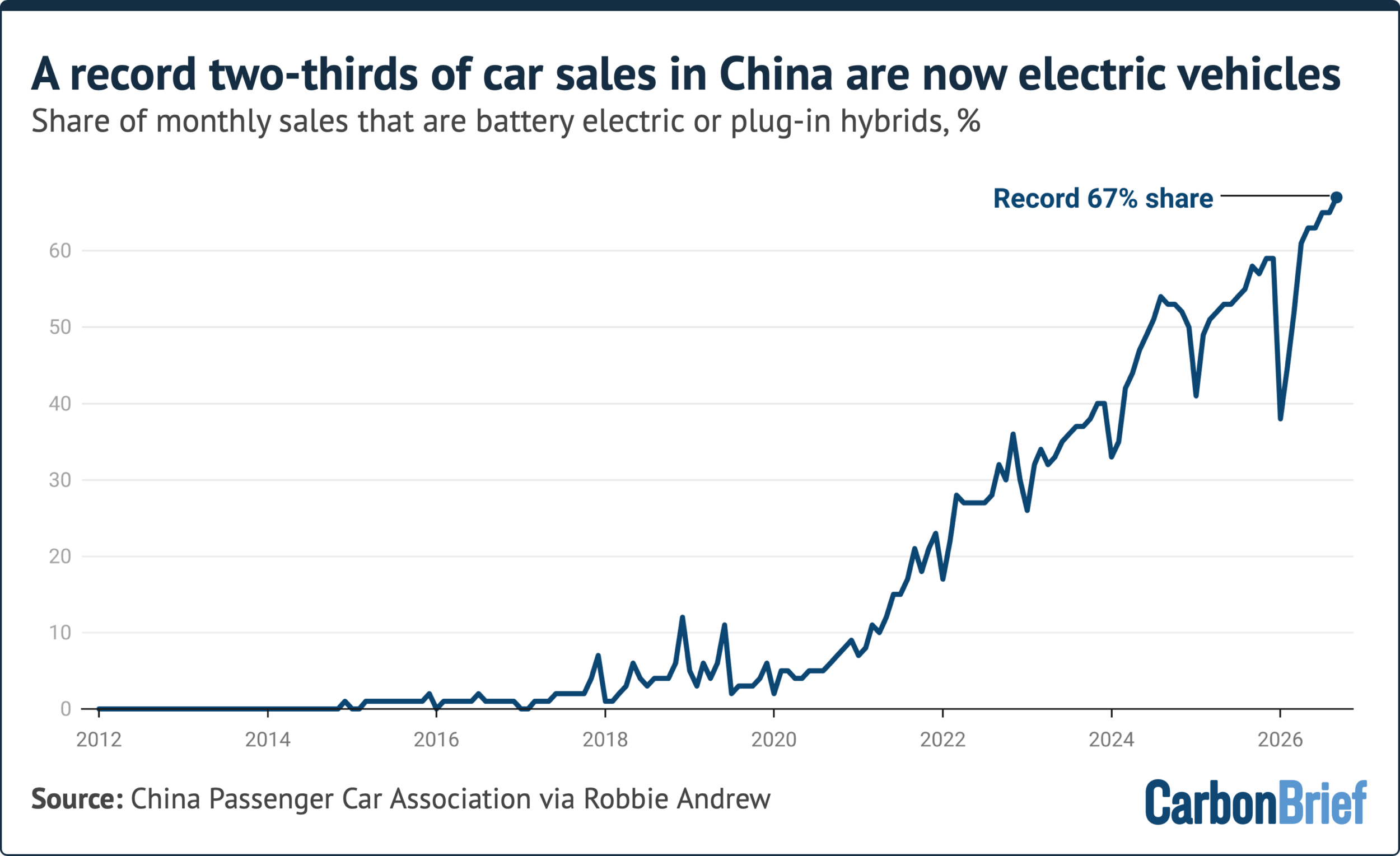 The penetration curve behind the headline: NEVs have gone from being a niche policy product to the default purchase choice inside China's passenger-car market.
None of this is a one-month blip. NEV penetration has climbed from just 6% of new car sales in 2020 up to 58% in 2026 to date, and to that record level in September. This year, the share also bounced back from a low of 39% in January, after the full purchase tax exemption that had been in place for more than a decade came to an end in December 2025. Underneath, the longer mechanic is well established: combustion-car sales in China peaked in 2017 and have been sliding across the past decade.
How the shift compounded: a five-step timeline
- 2017 onward — the demand plateau of the petrol powertrain. Engine, transmission and fuel-system volumes began their long decline, so the conversion of capacity was already under way before the 2026 price shock.
- 2020 — the low base. With NEVs at just 6% of new-car sales, early adopters and fleet buyers absorbed the cost curve that later scaled.
- December 2025 — the fiscal reset. The tax exemption's expiry pulled purchases forward and left January at 39% share before the recovery.
- Spring 2026 — demand-pull effects clear. Consulting firm Wood Mackenzie attributes part of the softness to "demand pull-forward" in 2025 and to "tighter financing conditions" for buyers and dealers.
- Hormuz — the fuel-price trigger. Higher pump prices converted a gradual substitution into a step change in buyer behaviour.
Step one of the mechanism: the energy shock did the selling
Cui Dongshu, secretary-general of the CPCA, pointed to higher petrol prices when explaining September's weak combustion-car sales in comments carried by financial outlet National Business Daily. Chinese technology outlet OFweek described the same fact from the sellers' side: petrol cars were "giving up market share" because electric alternatives were outperforming them.
Trade data confirm the squeeze at the port. Imports of oil into China in January-September have fallen 15% compared with 2025, equivalent to 470m barrels, as conflict tightened supply and drove up prices.
Two analyst estimates show how the same tonnage is counted. Euan Graham, senior energy analyst at thinktank Ember, tells Carbon Brief that China's passenger-car NEV fleet has offset demand for 143m barrels of oil since the start of the Hormuz crisis — phrased differently, the running fleet has displaced 143m barrels so far during the strait of Hormuz crisis. In an estimate supplied to thinktank the Brookings Institute, an analyst put the contribution as a share: EVs "accounted for 12% of the decrease in China’s oil use post-Hormuz".
Pump-price trackers supply the household arithmetic behind that displacement. CEIC's retail series for 92-octane gasoline shows about 8.7 yuan per litre in major Chinese cities in April 2026, against roughly 7 yuan after a mid-year price-window rollback — a swing large enough to change the monthly cost case for a works shuttle, a third-party logistics fleet or an employee's commute.
Erica Downs, a senior research scholar at Columbia University’s Center on Global Energy Policy, tells Carbon Brief that the strait of Hormuz crisis and higher oil prices are "reinforcing China’s electrification of road transport". Her reading is that the "world’s largest oil supply disruption" vindicates an industrial bet originally justified on oil-supply-security grounds — a reminder that energy policy and production planning are the same document viewed from two desks.
Step two: the mix inside the NEV basket moved against the compromise product
| Demand block | This September | 2026 to date | Operations read-through |
|---|---|---|---|
| Combustion-only cars | fall 43% year-on-year | 31% in 2026 to date | Engine blocks, tanks, exhaust and driveline tooling strand fastest |
| Plug-in hybrids | fell by 36% year-on-year | by 26% in 2026 to date | The bridging product is losing its bridge; dual-supply tooling gets harder to amortise |
| Battery EVs | declined 8.5% from a year earlier | 4% in 2026 to date | Holds volume best; cells, drives, software and charging become the real bottlenecks |
| All NEVs | fell by 17% | 13% in 2026 to date | Share still rose, because the denominator collapsed faster |
Read across the rows and a second story appears: the pure-electric product is no longer the risky option — the compromise product is. Purchasing managers who assumed hybrids would cushion a slow transition are now re-planning around battery architectures.
Step three: the supply-side tail the percentage hides
Two indicators that rarely travel with the record share explain how much pain sits behind it. On capacity, figures published by China's National Bureau of Statistics put automobile-manufacturing capacity utilisation at 70.3% in the first quarter of 2026 and 70.8% in the second quarter — under the 75% level Chinese industrial statisticians treat as healthy. On channel, trade-press summaries of China Automobile Dealers Association surveys describe more than 1,200 petrol-vehicle franchise stores exiting in the first quarter of 2026 alone, with loss-making combustion dealers outnumbering profitable ones while NEV showrooms stayed in the black.
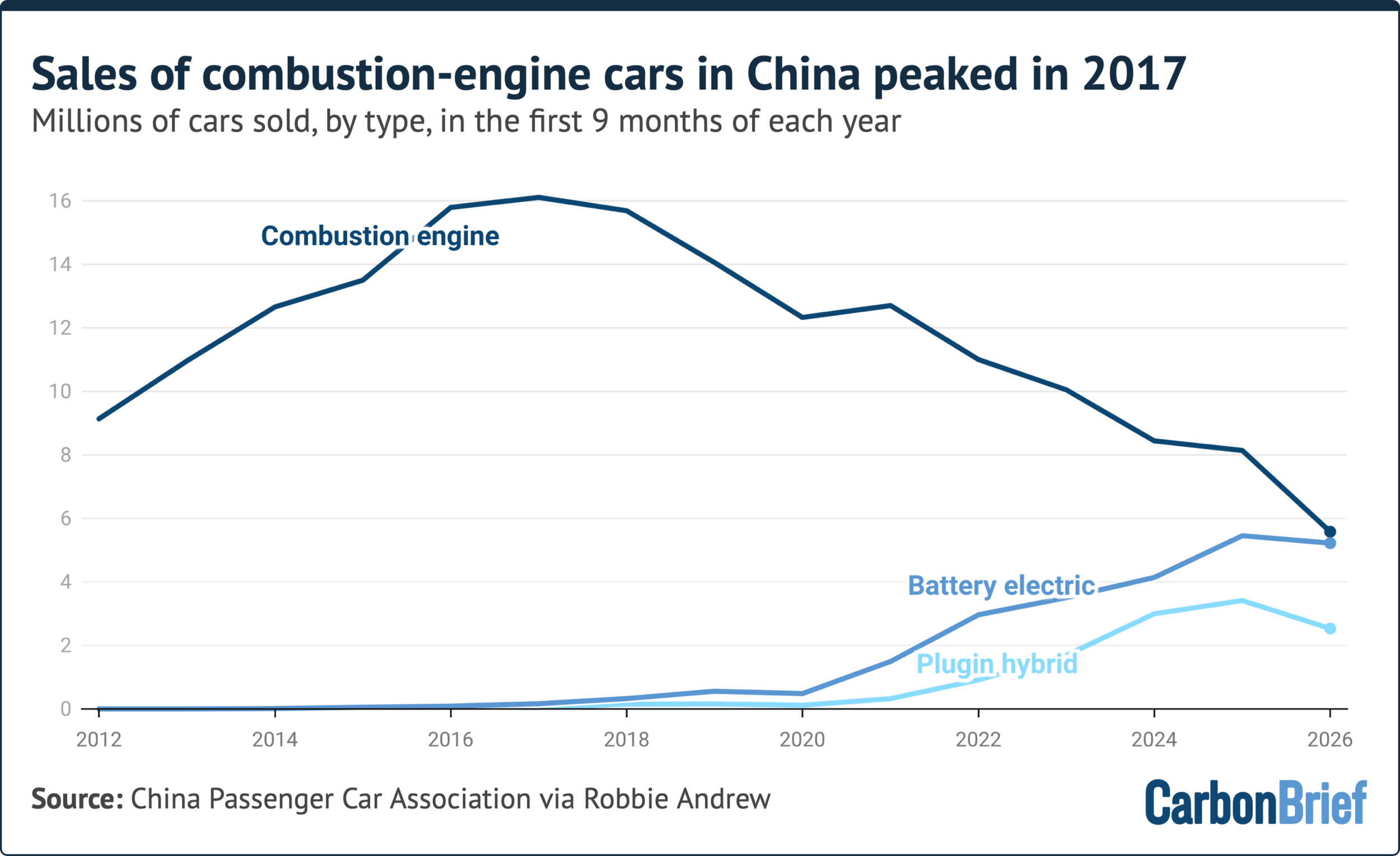 The long arc of the substitution: combustion-car volumes turning down well before the 2026 price shock arrived.
The practical conclusion for a supplier of camshafts, fuel rails or exhaust systems is uncomfortable but actionable: the decline is structural, not cyclical, and a capacity-utilisation average in the low 70s conceals a much colder tail where legacy lines idle.
Reference case: BYD's engine exit and what it looks like at scale
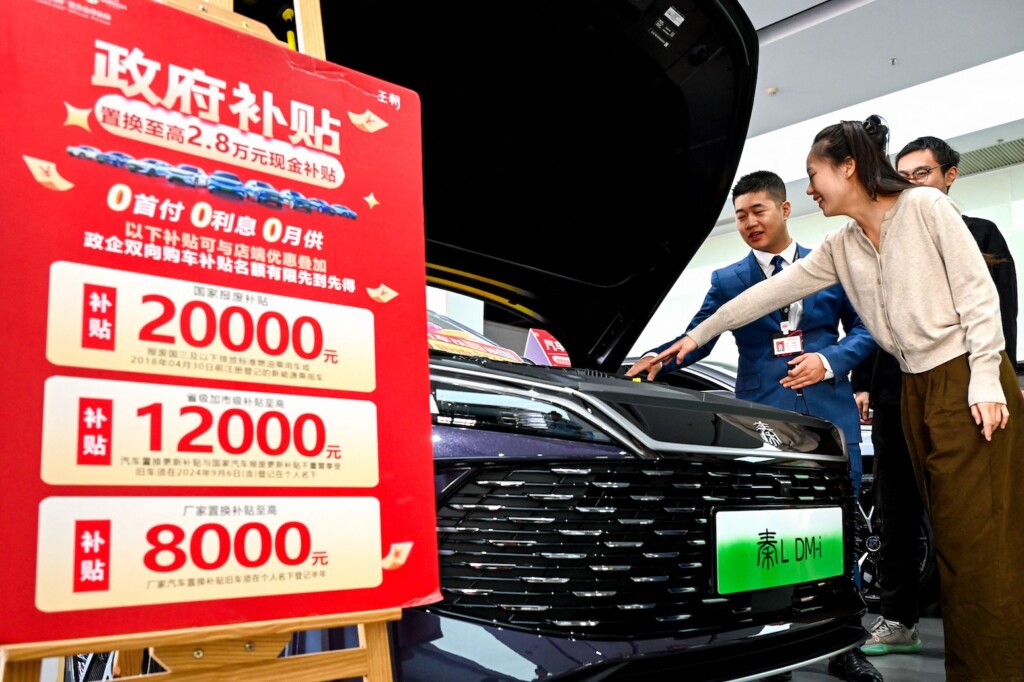 Buyers take delivery of new-energy vehicles during a trade-in promotion at a BYD 4S dealership in Nanchang, Jiangxi province. Image credit: Cynthia Lee / Alamy Stock Photo.
The visible end of that story — a crowded showroom in Nanchang — is the output of a decision taken four years earlier. As Reuters reported in April 2022, BYD announced that it had stopped producing full combustion-engine vehicles as of March that year and would build only BEVs and PHEVs. Three features of that conversion are what other plants are now copying: a hard calendar date published in advance, which let purchasing and tooling teams stop ordering long-lead engine equipment; line-by-line redeployment instead of plant closure; and an export push that gave the retooled capacity a second demand pool when the domestic price war tightened.
Exports: the second act, and its bottlenecks
Domestic NEV retail fell 17% in September 2026, while exports increased 164% year-on-year, according to the CPCA. In raw units, 1,084,000 NEVs were sold domestically in China and 558,000 were exported. The association says exports have become "a core priority" for some carmakers.
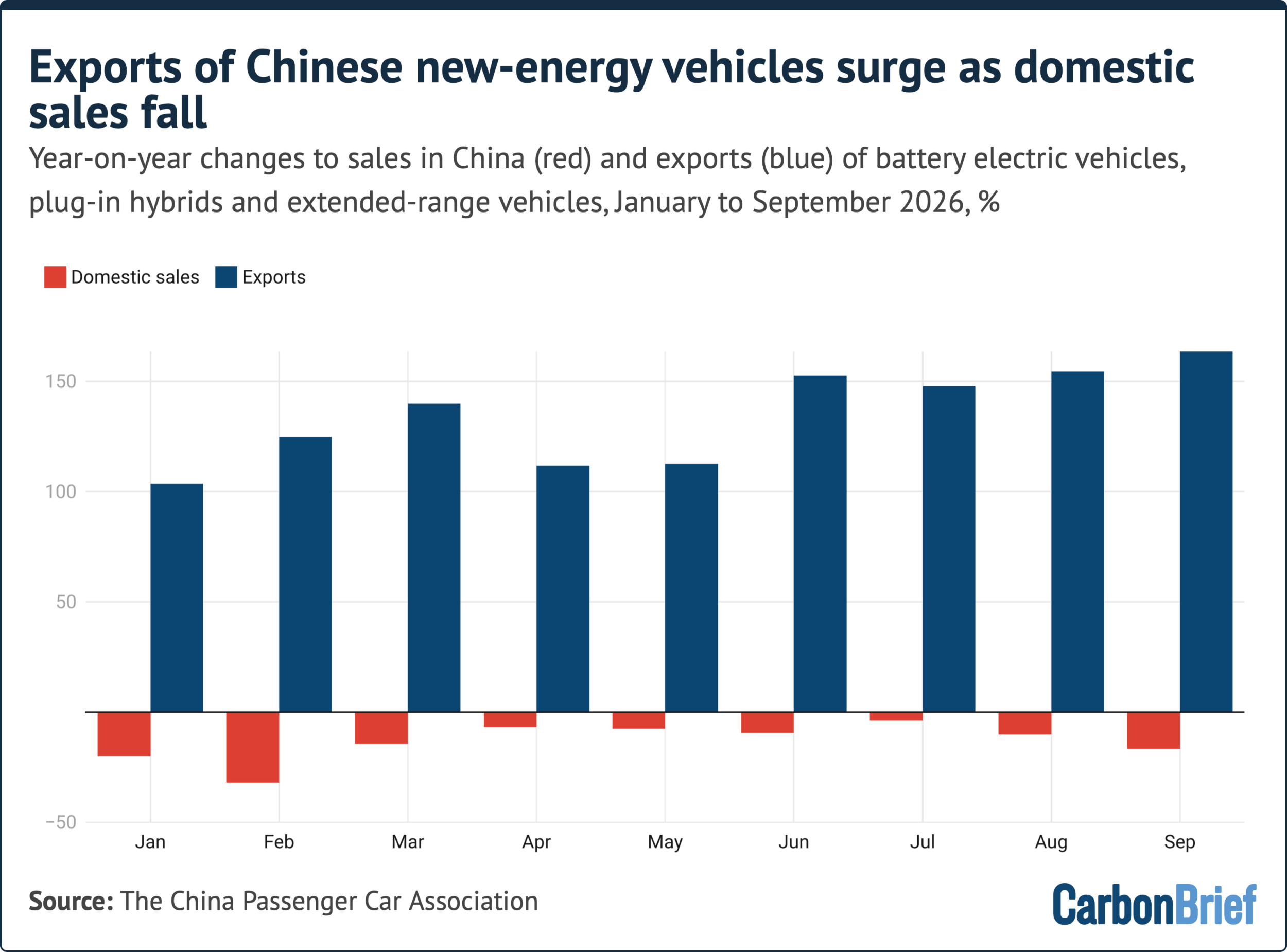 The divergence that defines 2026: a softening home market against an export line that keeps climbing.
That pivot has an industrial-logistics footprint. Writing for the CSIS ChinaPower project, analysts tracked how Chinese shipyards moved to deliver upwards of 200 ro-ro car carriers across the 2023-2026 window — because vessel space, not factory space, was binding on the export curve — and makers including BYD began commissioning their own carriers for the same reason. Infrastructure, not assembly capacity, is now the pacing item.
Policy pulls the other way. The EU has placed tariffs on imports of EVs from China and recently agreed plans to cut imports of hybrids; Mexico and Turkey have also placed tariffs on Chinese EV imports. At the same time, the Chinese government is putting in place measures such as cutting VAT export rebates that would normally disincentivise overseas sales; analysts split on whether the impact will be limited or will lift the price of exported cars.
For anyone shipping into Europe, the rules are being written in real time: the European Commission published a guidance document on 12 January 2026 setting out how Chinese exporters may submit price-undertaking offers as an alternative to tariffs (policy.trade.ec.europa.eu). That converts a tariff question into a compliance, pricing and product-mix engineering problem — the kind industrial affairs teams can actually prepare for.
Four misconceptions the headline invites
- "A record share means record demand." NEV sales fell by 17% in September and 13% in 2026 to date. Share rose only because combustion volumes fell faster.
- "Policy alone produced the numbers." Cui told state-run China National Radio that September's decline against the same month in 2025 also reflected a high base, changes to trade-in rules and holiday-period disruption. Zhang Yichao, a partner at consulting firm AlixPartners, notes NEVs still benefit from government trade-in policies and a "strong pipeline" of innovative models — which explains a shallower fall, not growth.
- "The curve runs to 100%." Zhang says he does not "see much more room ahead" and that NEV share is unlikely to exceed 80%, because premium segments and specific duty-cycle uses will keep internal-combustion vehicles in the mix.
- "Export volume can absorb any domestic slack." Tariffs in three jurisdictions, a rebate rollback and finite vessel capacity all set a ceiling on how much of the plant problem can be shipped away.
Reusable playbook: six moves for operations, procurement and channel teams
- Separate share from volume in every forecast you buy. Budget against units by powertrain, not against penetration rates; a rising mix percentage can hide a falling order book.
- Stress-test input costs against energy scenarios. A single shipping chokepoint moved the buyer's decision by tens of percentage points in one quarter; run the same scenario on freight, resin, steel and electricity contracts.
- Set a public conversion date for legacy lines. The BYD precedent shows that a dated commitment is cheaper than a slow retreat, because tooling, supplier agreements and staffing can be re-planned once rather than repeatedly.
- Re-price the bridging product. If plug-in hybrids fall faster than both battery EVs and pure combustion cars, dual-architecture investment needs a harder justification than "hedging".
- Treat logistics capacity as a design input. Ro-ro space, port windows and customs pricing mechanisms now constrain export plans before machine tools do.
- Build a service annuity around installed ICE fleets. Parts, warranty and maintenance revenue outlives new-vehicle demand by a decade, and it is where shrinking dealer networks can be turned into margin.
FAQ
Why did penetration hit a record if everything sold less?
Because the denominator moved faster than the numerator. Total passenger-car retail fell, combustion volumes collapsed and NEVs lost less ground, so the share printed a record even as absolute NEV demand declined.
Is the fuel-price explanation credible?
It is the most-cited one, and it is consistent with the trade data: oil imports down 15% year on year over nine months, a 470m barrel equivalent, and an NEV fleet that has displaced a further 143m barrels of demand since the crisis began.
What is the ceiling on this transition?
AlixPartners' Zhang Yichao sees limited room left and puts the practical ceiling below 80% share, on the basis that some premium and specialist use cases still require combustion engines.
Should suppliers of combustion components exit now?
Not necessarily — but they should stop underwriting volume recovery. Divert capital to redeployable machining cells, rework and refurbishment services, and aftermarket contracts tied to fleets that will run for years after assembly lines convert.
Version of record: the numbers above come from CPCA monthly data as originally compiled by Carbon Brief, with additional capacity, channel, shipping and trade-policy context drawn from China's National Bureau of Statistics, Reuters, CSIS ChinaPower and the European Commission's trade dossier. Tips, corrections and dataset requests for Industrial Weekly's manufacturing desk: news@industrialweekly.com.