
Case Files From the Storage Bench: BIWIN's 122.88 TB SSDs, Win-REC Video Drives and ePoP5X Ahead of electronica 2026
By Michael Torres, Industrial Weekly
Nobody on a factory floor, in a control room, or on a vehicle platform team shops for storage the way a brochure sells it. Terabytes and megabytes per second only become decisions once they are tied to a duty cycle: a camera wall that never stops writing, a GPU node that must drain checkpoints before the next epoch, a parked car facing three weeks of sleep cycles, a headset with two square centimetres of free board area left. Rather than re-list the announcements, this review reads the BIWIN lineup assembled for electronica 2026 as four deployment stories and pulls out what each one teaches a design or purchasing group before the Munich doors open.
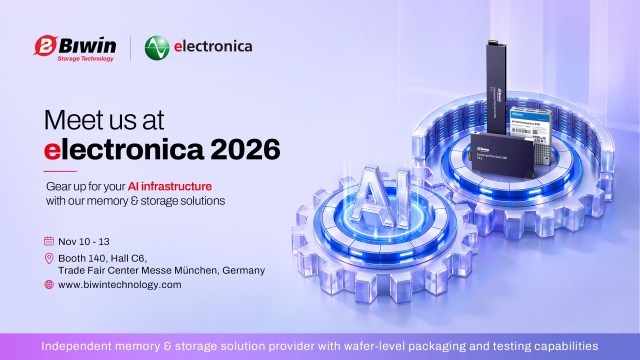
BIWIN, a provider of memory and storage solutions, takes part in the show held November 10-13 at Trade Fair Center Messe München in Germany, presenting technologies for AI infrastructure, industrial edge computing, intelligent vehicles, embedded devices and compact PCs. Its in-house reach across hardware, firmware, storage algorithms, packaging, testing and manufacturing explains why the portfolio stretches from hyperscale capacity points down to package-level integration instead of clustering in a single product category.
Why a component fair is now a storage argument
The setting itself carries information. electronica brings the electronics supply chain to one site every two years; event pages published by exhibitors such as Rohde & Schwarz record more than 3,480 exhibitors and over 80,000 visitors at the previous edition, with the show billed as covering automation with AI, electromobility and smart energy. That crowd mix is the point: for Industry 5.0 platforms that run 24/7, storage sits between compute selection and facility planning, so a drive choice made during a component review can reappear later as a cooling, rack-power or downtime line item.
Case 1 — AI training cluster: three questions, three drives
Situation. A GPU cluster running mixed training and inference wants throughput for checkpoints, density for the data lake, and watts that do not force a facility upgrade.
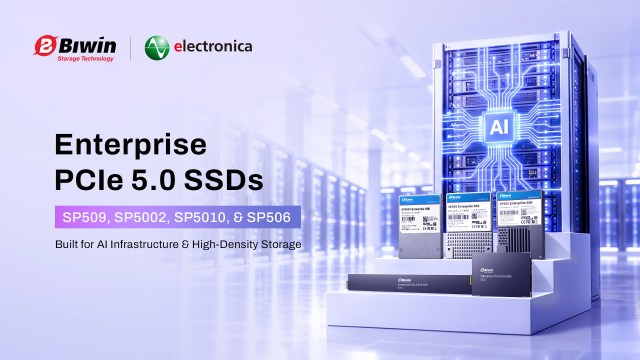
What is on the bench. The SP509/SP519 line is a high-performance, highly reliable PCIe Gen5 x4 enterprise SSD family tuned for the I/O demands of AI training and inference, reaching sequential read/write speeds of up to 14,700/9,000 MB/s and 4K random read/write performance of up to 3,200K/800K IOPS. SP5002, built on high-density QLC NAND, provides up to 61.44 TB in EDSFF form factors for data lakes, cloud infrastructure and high-density storage. SP5010 is a 2.5-inch U.2 PCIe Gen5 x4 enterprise SSD offering up to 122.88 TB per drive while reducing power consumption, rack footprint and data center TCO. For hyperscale environments, SP506/SP516 pairs PCIe 5.0 performance with OCP 2.0 compliance and high performance-per-watt efficiency.
Friction that shows up later. Bandwidth is not free thermally. Market analysis of data-center SSD adoption notes that PCIe 5.0 drives can dissipate up to 18 W under load, which pushes some operators to revise cooling before they can hold rated capacity (mordorintelligence.com, solid-state-drive market report). Interoperability is equally a paper exercise: hyperscale buyers increasingly align drives against the Open Compute Project's Datacenter NVMe SSD Specification, which standardizes health reporting, telemetry and endurance disclosure so fleets can be compared on identical metrics (opencompute.org).
Reusable lesson. BIWIN does not use one enterprise SSD design for every workload; it shapes solutions around differing priorities in endurance, density, power efficiency, interoperability and latency. A platform team should mirror that and open three requirement rows — hot tier, capacity tier, standards-compliant fleet tier — rather than one generic line item.
Case 2 — The camera wall that never stops writing
Situation. A transit authority or plant security group needs recorded video to land on disk without frame drops, in a cabinet that sees both winter and summer extremes.
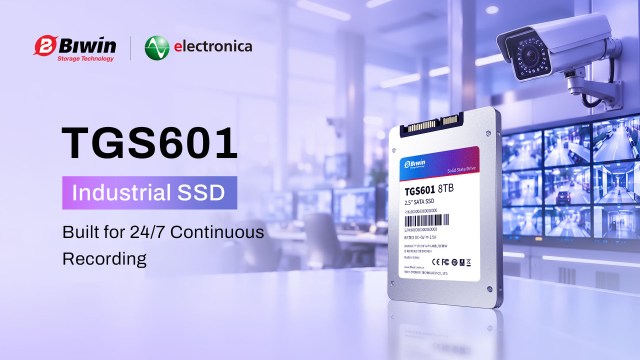
What is on the bench. BIWIN TGS601 Industrial SSD is designed for sustained, always-on workloads in industrial and edge systems, with Win-REC, the vendor's proprietary intelligent write algorithm for continuous video recording, at the core of the drive. A single TGS601 can support recording from up to 24 simultaneous video streams while maintaining consistent write performance, helping reduce frame drops and recording interruptions in surveillance and other video-intensive deployments. Wide-temperature operation from -40°C to 85°C, full-capacity onboard DRAM, hardware-based power-loss protection and multi-layer data protection support deployment in autonomous security systems, intelligent transportation, in-vehicle surveillance, edge computing and industrial servers. The same drive is positioned as the high-capacity buffer for Edge AI perception engines and the ruggedized, fail-safe platform needed for Physical AI control loops.
Friction that shows up later. Continuous-record duty is where consumer parts fail quietly. Storage vendors that publish surveillance guidance describe purpose-built media as rated for nonstop multi-stream writing with reduced frame loss rather than for burst performance (westerndigital.com; industrial.adata.com NVR storage guide). The failure is rarely headline speed — it is write amplification, cache behaviour and a corrupted file after an uncontrolled power cut.
Reusable lesson. Test the recorder, not the datasheet: run the actual channel count and codec mix for a full retention cycle, then pull the plug mid-write. With TGS601, BIWIN moves workload-specific optimization into the drive itself, targeting the sustained write behaviour and operating conditions that define industrial storage in the field.
Case 3 — The parked vehicle and the 105°C line
Situation. A cockpit or domain-controller programme must keep storage alive through parked sleep, a hot cabin and a growing backlog of logged data.
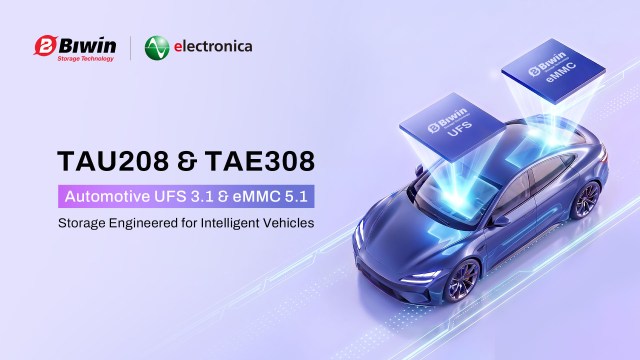
What is on the bench. BIWIN's automotive portfolio covers the growing data requirements of intelligent cockpits, infotainment, navigation, digital instrument clusters, T-BOX modules and domain controllers. TAU208 UFS 3.1 pairs automotive-grade reliability with intelligent power and storage management; its Deep Sleep mechanism can reduce sleep-mode power consumption by up to 95%, while Performance Throttling Notification and Error History logging provide additional capabilities for managing storage within vehicle systems. TAE308 eMMC 5.1 extends the portfolio with an embedded solution built around BIWIN's self-developed controller, with reliable deployment across demanding automotive environments supported by AEC-Q100 Grade 2 qualification and operation from -40°C to 105°C. Together, TAU208 and TAE308 give automotive platform developers storage options for different performance and integration requirements as vehicle architectures become more centralized, connected and software-defined.
Friction that shows up later. Two numbers do the real work. The grade boundary is not marketing: AEC-Q100 temperature grades are defined by ambient range, with Grade 2 covering -40°C to +105°C, Grade 1 to +125°C and Grade 3 to +85°C, according to the qualification summary maintained in the Infineon developer community — so the grade you accept should follow the physical mounting zone. Data volume is the other: analysis of automotive data management records modern vehicles generating up to 25 GB of data per hour, with advanced prototypes exceeding 4 TB daily (mordorintelligence.com), which is what makes in-vehicle retention and offload strategy a platform decision rather than a component afterthought.
Reusable lesson. Sleep-state draw belongs in the vehicle energy budget, not the storage datasheet. Error History logging is an operations feature before it is a firmware feature: it is what tells a fleet manager whether a module is degrading.
Case 4 — The device with no board area left
Situation. A handheld, a compact PC or a pair of AI glasses reaches the point where the memory and storage components, not the silicon, decide the enclosure.
What is on the bench. BIWIN BL130 Mini SSD brings PCIe Gen4 storage into an ultra-compact removable form factor, giving OEMs a way to put SSD-class storage into handheld gaming devices, compact PCs, smart cameras, edge AI platforms and other systems where internal space is limited, with sequential read speeds up to 3,700 MB/s and capacities up to 2 TB. Its smaller footprint opens room inside the device, giving product designers greater flexibility over system layout while making thinner, more integrated designs possible without sacrificing removable storage. On the other axis, BIWIN ePoP5X combines LPDDR5X memory and eMMC storage in a compact Package-on-Package solution, reducing the PCB space needed for separate components and giving designers of next-generation industrial devices, AI glasses and other space-constrained hardware more flexibility to fit more memory and storage into compact systems.
Friction that shows up later. Miniature removable storage has become its own market: roundups of the 22 x 30 mm size class describe a segment that grew from a Wi-Fi-module niche into a consumer upgrade path after handheld gaming PCs arrived, with thermal headroom inside a sealed chassis doing more to limit real-world speed than the interface itself (gamingpcbuilder.com). Package-on-Package solves a different problem — it buys board area, but ties memory capacity to the storage decision at order time.
Reusable lesson. BIWIN approaches miniaturization from multiple directions: BL130 reduces the footprint of removable high-performance storage, while ePoP5X combines memory and storage within a single package. Choose by what you are short of — serviceability, or square millimetres.
Cross-case read: the same method at four scales
At electronica 2026 the products address storage challenges at very different scales. SP5002 brings higher density to data infrastructure with capacities up to 61.44 TB, TGS601 uses Win-REC to handle sustained multi-channel video recording, ePoP5X integrates memory and storage in a single package, and BL130 brings removable PCIe storage into a much smaller footprint. The differences go beyond form factor or performance: each solution is developed around how and where the storage will be used, with product architecture and firmware shaped by the demands of the target system.
| Deployment story | What breaks first | Drive on the bench | What to verify before ordering |
|---|---|---|---|
| GPU training and inference node | Checkpoint I/O stalls; rack power | SP509/SP519, SP506/SP516 | Sustained 4K random under real load, OCP telemetry parity |
| Dense cloud capacity tier | Drive count and TCO per rack | SP5002, SP5010 | QLC endurance class, thermal envelope at full utilisation |
| 24/7 camera and edge recorder | Frame drops, corrupt files after power loss | TGS601 Industrial SSD | Multi-stream write consistency, DRAM and power-loss design |
| Cockpit, T-BOX, domain controller | Parked sleep current; cabin heat | TAU208, TAE308 | AEC-Q100 grade against mounting zone, log export |
| Handheld, compact PC, smart glasses | Board area and enclosure thickness | BL130, ePoP5X | Removability versus package integration; thermal path |
Common mistakes this lineup argues against
- Specifying "a PCIe 5.0 SSD" as one checkbox instead of separate hot, capacity and fleet-compliance requirements.
- Reading sequential MB/s on a camera-recorder application, where sustained multi-stream write behaviour is what shows up in incident reports.
- Treating industrial and automotive temperature claims as interchangeable: -40°C to 85°C on a recorder is a different qualification path from AEC-Q100 Grade 2 and -40°C to 105°C on a vehicle part.
- Ignoring sleep-mode draw until a parked-vehicle battery warranty issue forces the question.
- Choosing a tiny removable drive without checking the chassis's ability to shed heat, which caps real throughput.
- Skipping OCP 2.0 conformance on a hyperscale fleet, where comparable health and endurance reporting is the basis for capacity planning.
Action list for the Munich week
- Write three workload rows for your own site — data-centre tier, edge recorder tier, embedded or device tier — and refuse to collapse them into one part number.
- Convert per-drive wattage into a facility number before discussing capacity: drive count times worst-case draw against the cooling you actually have.
- Ask every vendor for sustained-write evidence and an unplanned-power-loss test report, not peak IOPS alone.
- Map automotive grade to the mounting zone; if the part sits in the cabin or near a drivetrain component, a grade that looks sufficient on paper may not be.
- Book a design slot at Hall C6, Booth 140 with your platform requirements in writing; the show runs November 10-13, 2026.
- Decide early whether your enclosure needs board area back (package integration) or a serviceable card (removable footprint), because those two answers come from different engineering disciplines.
FAQ for industrial buyers and engineers
Which drive fits a 24-channel recorder?
BIWIN positions TGS601 Industrial SSD for that duty: Win-REC manages the continuous write pattern, a single drive supports recording from up to 24 simultaneous video streams, and the part is specified for wide-temperature operation from -40°C to 85°C with onboard DRAM and hardware power-loss protection.
What is the practical value of a 122.88 TB drive?
Capacity per drive is the lever that reduces drive count, rack footprint and data center TCO, which is the stated basis for SP5010, a 2.5-inch U.2 PCIe Gen5 x4 enterprise SSD. Where density is prioritised over the U.2 form factor, SP5002 reaches up to 61.44 TB in EDSFF.
Should a cockpit programme choose UFS or eMMC?
It depends on the performance and integration requirement. TAU208 UFS 3.1 is aimed at higher-performance cockpit and domain workloads and adds the Deep Sleep mechanism that can cut sleep-mode power consumption by up to 95%; TAE308 eMMC 5.1 serves embedded applications needing a controller-integrated, AEC-Q100 Grade 2 qualified part rated -40°C to 105°C.
Where can these be seen in person?
BIWIN will show its enterprise, embedded, industrial, automotive and PC OEM storage technologies, with discussions on platform requirements and storage development, at Hall C6, Booth 140 during electronica 2026, November 10-13, at Trade Fair Center Messe München, Germany.
About the exhibitor
BIWIN Storage Technology Co., Ltd. (SSE STAR Market, Stock Symbol: 688525) is a high-tech enterprise focused on research, development, packaging, testing, production and sales of semiconductor memory and NAND Flash storage solutions, recognised across enterprise, data center, automotive, industrial and consumer markets, and distinguished by in-house R&D capabilities spanning hardware, software, firmware, storage algorithms and advanced packaging and testing. Its product portfolio includes PCIe NVMe SSDs, SATA SSDs, enterprise SSDs, DRAM modules, embedded storage solutions (ePoP/eMMC/UFS), automotive and industrial-grade storage solutions, portable SSDs, memory cards and USB flash drives.
Exhibition details
- Booth: Hall C6, Booth 140
- Date: November 10-13, 2026
- Location: Trade Fair Center Messe München, Germany
Editorial note: this case review was prepared by WorldIndustrialWeekly's General desk from the exhibitor briefing and publicly available industry material cited in the text. Reference points include the Open Compute Project storage specifications (opencompute.org), the AEC-Q100 temperature-grade summary published by Infineon's developer community, SSD market analysis from Mordor Intelligence, surveillance storage guidance from Western Digital and ADATA Industrial, and M.2 2230 market roundups. Readers with a deployment story of their own can reach the newsroom at news@industrialweekly.com.