
NextDent 300 in Europe: A Practical Deployment Guide for Labs as BioSummer Dental Widens the 3D Systems Channel Under EU MDR
A channel agreement rarely reads like an industrial event. But when a long-standing distributor adds one specific machine to its catalogue and begins queuing the first units for named strategic customers, the conversation shifts from whether the technology works to who now owns the installation problem. That is the useful way to read the recent expansion of the strategic distribution partnership between 3D Systems and BioSummer Dental, a France-based distributor of advanced digital dentistry solutions: the NextDent 300 MultiJet 3D printer has moved into a live production portfolio, and the operational questions — cell throughput, labour redesign, validation evidence, file ownership — land on the buyer's desk.
The hinge is dated rather than rhetorical. The NextDent Jet Base and Teeth materials received clearance under the EU Medical Device Regulation (EU MDR 2017/745) in April 2026, which enabled commercialization throughout the European Union; company materials reported in March 2026 pointed to a summer 2026 commercial window in EU markets. Everything below assumes an operations team that now has to convert that regulatory milestone into predictable output across Europe.
1. What Actually Changes on the Bench
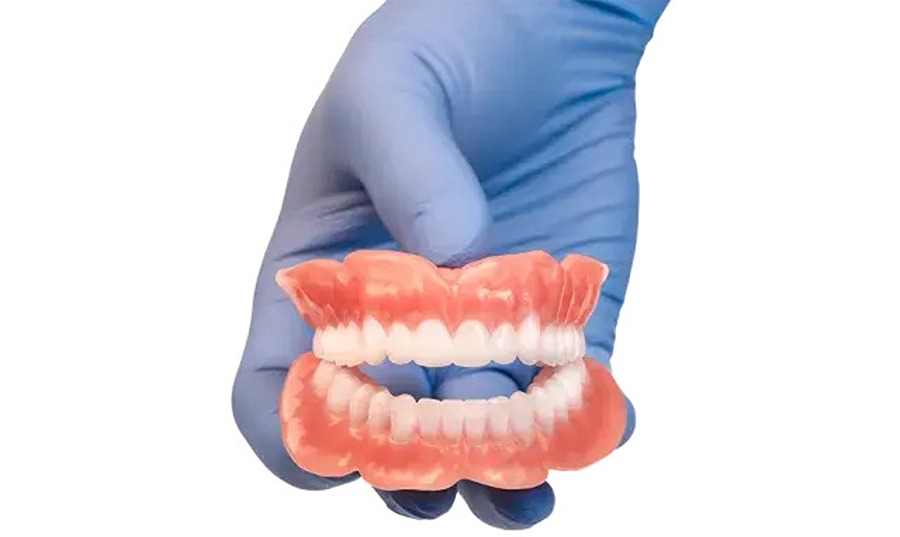
The NextDent Jetted Denture Solution is built around multi-jet printing: base and teeth materials are deposited in a single pass, so the finished arch arrives as a monolithic, patient-specific part rather than an assembly of separately fabricated components. The manufacturer's stated value proposition is a streamlined, integrated workflow that reduces labour-intensive manual processes while holding aesthetics and durability, which lifts efficiency, productivity and consistency of delivery.
For a plant-floor reader, three consequences matter more than the rest:
- Batching becomes the unit of planning. Industry reporting on the machine lists a build envelope of 294 x 211 x 50 mm (11.6 x 8.3 x 2.0 in), with space for an average of 15 dentures per run — scheduling around a nest, not around a single case, changes how work orders and due dates are written.
- Labour moves, it does not vanish. Hand waxing and set-up steps shrink; nesting, support removal, finishing, shade verification and record-keeping grow. Reallocate your most experienced technicians to validation rather than replacing them.
- Capital is only part of the number. Lab-owner discussions on industry forums have put a fully configured cell, printer plus post-processing, in the region of $75,000 (dentallabnetwork.com, a practitioner forum rather than a published price list) — treat it as a budgeting prompt to validate with the distributor, not a quote.
2. Why the Channel Model Is the Industrial Signal
Distribution depth is a proxy for production maturity. A vendor can demo a printer anywhere; only a certified, supportable platform gets a regional partner to stock it, train field staff and place units with strategic customers. BioSummer Dental's role — an established footprint in the dental industry combined with digital-workflow expertise — is to make these capabilities reachable for laboratories, and its addition of the NextDent 300 positions it to support broader adoption as labs look for more efficient ways to meet rising production demand.
The wider pattern reinforces the point. Alongside the France arrangement, 3D Systems has been signing regional channel partners for the same machine in other European markets (cdg.uk.com), and in October 2026 the company donated a NextDent 300 MultiJet 3D printer to Remote Area Medical to support free denture care for underserved patients (stocktitan.net). A platform that is being placed in both commercial labs and charity clinics is a platform being hardened into routine service conditions.
3. Demand Context: Numbers Worth Putting in the Business Case
Two external data sets frame why industrial-interest readers should track this category rather than file it under dental news:
| Dimension | Reported figure | Source |
|---|---|---|
| Global dental 3D printing market, 2026 → 2031 | USD 4.35 billion → USD 10.08 billion, 18.3% CAGR | MarketsandMarkets, via PR Newswire |
| US digital denture market, 2025 → 2031 | USD 516.0M → USD 806.0M, 6.5% CAGR | MarketsandMarkets |
| Employment outlook, dental and ophthalmic laboratory technicians and medical appliance technicians, 2025–2035 | projected to decline 2 percent | US Bureau of Labor Statistics, Occupational Outlook Handbook (bls.gov) |
| Addressed population cited by the manufacturer | roughly 180 million denture wearers worldwide; about 13.7 million dentures produced annually | 3D Systems statements, as reported by industrysourcing.cn |
The BLS line is the one to underline in a capacity meeting. A flat-to-declining technician pool against a market for printed dental devices expanding at double-digit rates is the definition of a forced automation problem: output growth will have to come from cells, not headcount. That is the same arithmetic that has pushed additive adoption in other regulated batch sectors.
4. Nine-Step Deployment Checklist
Use this as a gate review, not a wish list. Teams that skip steps 2, 3 and 6 are the ones that stall after the first installation.
- Baseline before you buy. Record labour hours per arch, remake rate, dispatch cycles, cost per case and on-time delivery for the twelve weeks prior. Without this, no efficiency claim can be audited.
- Confirm who holds the regulatory file. Under EU MDR, a Class IIa pathway means Notified Body involvement rather than self-declaration, plus a documented, auditable quality management system, an EU declaration of conformity, and UDI/EUDAMED registration duties (registrarcorp.com; webgate.ec.europa.eu). Establish whether the lab operates under the custom-made device route or as part of a certified system supplied by the manufacturer.
- Buy the system, not the parts. Certification applies to the paired materials and printer as a validated set — the NextDent Jet Base and Teeth materials cleared in April 2026. Substituting resin or a third-party cleaning cycle invalidates the biocompatibility and performance evidence.
- Prep the facility. Stable power, local exhaust ventilation for uncured resin, temperature-controlled material storage, floor space for wash and cure stations, and safe handling procedures for skin-contact protocols.
- Map skills to the new task split. Identify who becomes the nesting operator, who becomes the finishing technician and who owns first-article inspection. Reallocating an experienced technician to validation is usually cheaper than hiring.
- Run a documented validation lot. Test dimensional fit against the source scan, base-to-tooth bond strength, shade consistency across multiple arches in one nest, and repeatability over at least three consecutive builds.
- Rewrite the intake contract with clinics. Scan quality, bite records and arch data are now inputs to a printing cell; ambiguous files become scrapped nests instead of scrapped wax-ups.
- Set batch economics and price. Convert per-nest throughput into cost per arch at 40%, 60% and 90% utilisation before promising any delivery time.
- Instrument from day one. Track arches per build, first-pass yield, remake rate, labour minutes per arch and machine utilisation; review weekly for the first quarter.
5. Common Misconceptions
- Certification means any lab can market the output as its own device. It does not. Clearing a material set under the EU Medical Device Regulation says nothing about the lab's own obligations or its right to place parts on the market.
- A printer purchase equals a digital workflow. If scanning, design and nesting stay manual or inconsistent, throughput gain is absorbed by set-up time.
- Vendor cycle-time claims equal validated cycle time. Published claims of large efficiency gains and materially reduced manual labour are measured under defined conditions; your numbers depend on arch mix and operator count.
- Larger nests are always better. One defective arch in a full nest of fifteen concentrates risk; batch size should follow yield data, not brochure capacity.
- This is only for high-volume labs. Small labs with technician shortages often gain proportionally more, but they carry higher utilisation risk if a single operator is the only trained person.
- The channel partner is just a reseller. In practice the local distributor carries installation, training, spare parts and application support — the constraint most pilots discover too late.
6. Risk Register for the First Two Quarters
| Risk | First symptom | Mitigation |
|---|---|---|
| Regulatory scope drift | Labs assume distributor certification covers their own placing of devices on the market | Written responsibility matrix with the distributor before the first unit is switched on |
| Material single-source dependency | Lead-time gap on certified base or teeth resin halts all printing | Safety stock sized to your build cycle plus a named escalation route to the partner |
| Yield concentration in large nests | Scrapped multi-arch runs after one bonding or shade defect | Stage nest size against first-pass yield; log defect mode per position in the build |
| Operator concentration | One trained person on shift; downtime on absence | Cross-train at least two operators before the pilot scales |
| Intake data quality | Rework traced back to clinic scans, not the printer | Reject criteria and a shared scan protocol agreed in writing with referring clinicians |
7. A 30 / 60 / 90-Day Action Plan
- Days 1–30: baseline metrics; regulatory responsibility matrix with the France-based partner; facility survey; capital request validated against distributor quotes rather than forum estimates.
- Days 31–60: install, commission and run three validation builds; cross-train two operators; agree intake protocols with the top five referring clinics.
- Days 61–90: publish first cost-per-arch and yield numbers; decide nest size and promised lead time; open the post-market surveillance and complaint route required by the QMS.
8. FAQ
Does the April 2026 certification cover the whole European Union?
Yes. Certification of the NextDent Jet Base and Teeth materials under EU MDR 2017/745 in April 2026 enabled commercialization throughout the European Union, which is what makes the wider distributor rollout across Europe possible.
What is the practical difference between this and conventional denture fabrication?
The NextDent Jetted Denture Solution produces monolithic dentures in an integrated workflow instead of assembling separately processed components, so repetitive manual steps are reduced and quality depends more on the digital file and more on batch consistency.
Who should we talk to first, the manufacturer or the distributor?
For availability, installation, training and service in France and neighbouring markets, the distributor is the working contact; for certification scope and material questions, insist on written documentation traced back to 3D Systems.
Is the labour reduction a headcount plan?
It should not be treated as one. With technician populations projected to decline, the realistic plan is redeployment of scarce manual skills into validation, finishing and supervision of cells.
What is the smallest credible pilot?
Three consecutive validated builds of a representative arch mix, with intake, nesting, printing, finishing and inspection all documented, and a measured cost per arch at realistic utilisation.
Bottom Line
Regulatory clearance opens a market; only a trained, instrumented cell earns it. The partnership's stated intent is shared by both parties: to accelerate the adoption of digital denture workflows and bring advanced manufacturing solutions within reach of dental professionals across France and the rest of Europe. For industrial readers, the takeaway is narrower and more transferable — when a certified machine and its certified materials reach a regional distributor's stock list, the winners in the next eighteen months will be the operations teams that arrived with a baseline, a validation plan and a written answer to who owns the compliance file.
By Michael Torres, WorldIndustrialWeekly. To share a deployment case with the Industrial Weekly editorial desk, write to news@industrialweekly.com.