
WorldIndustrialWeekly General Comparison: Arduino Nano XL Link vs Nano XL Link Connector Carrier — Choosing Between CAN FD, RS485 and Ethernet
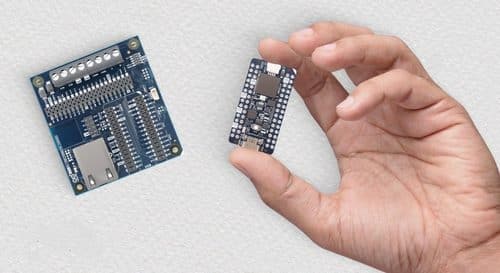
The choice is usually made on the bench, not in a datasheet: a bare Arduino Nano XL Link puts CAN FD at up to 8Mbps, RS485 and 10/100Mbps Ethernet on one Nano card, while the Nano XL Link Connector Carrier turns the same three signals into screw terminals and an RJ45 jack for a DIN-rail panel. Prototype on the first, ship the second; choose the interface by distance and topology, not by headline rate.
Both products were unveiled at electronica 2026, with Arduino's announcement dated 10 November 2026. The premise is narrow and useful: keep the familiar Nano footprint, drop the stack of add-on communication modules, and let one board talk to motors, field sensors and building controllers directly. Arduino has not published pricing or an on-sale date for either product, so a rollout plan has to treat availability as an open variable.
What actually changed in the Nano lineup in 2026?
Bottom line: Arduino did not shrink a larger board. It kept the Nano form factor and integrated three wired interfaces that previously needed daughterboards. The Arduino Nano XL Link carries CAN FD, RS485 and 10/100Mbps Ethernet on board, so a node can address industrial networks, motors, sensors and building control systems without external communication hardware. That integration is the product story; the rest is packaging and tooling around it.
The consequence is a shorter bill of materials for gateway and controller designs, but also a harder commitment: once the physical interfaces are on board, you cannot swap the layer later without changing the board. This review therefore compares the two announced SKUs and the three interfaces against the criteria a plant team actually uses — cable reach, node count, deterministic timing and panel space — rather than repeating the announcement.
CAN FD, RS485 or 10/100Mbps Ethernet: which interface fits your job?
Conclusion: match the interface to distance, node count and bandwidth. CAN FD suits deterministic machine control, RS485 suits long multi-drop runs, and Ethernet fits where an IP network already exists. Headline speed misleads: classical CAN stops at 1 Mbit/s, while CAN FD holds that rate during arbitration and accelerates the data phase to 2–5 Mbit/s in typical implementations, according to Influx Technology. RS485 can reach roughly 1,200 m at low baud rates, but usable rate falls as distance grows, notes Analog Devices.
| Interface | On-board device | Rate | Best fit (analysis) |
|---|---|---|---|
| CAN FD | TCAN3414 (Texas Instruments) | up to 8Mbps | motor control, machine nodes, gateways |
| RS485 | THVD2410 | — | long cable runs, multi-drop sensors |
| Ethernet | KSZ8081 Ethernet PHY (Microchip) | 10/100Mbps | IP networks, supervisory links |
Topology is the second filter. CAN FD and RS485 are multidrop buses where every node shares one failure domain; Ethernet is switched, so a single cable fault is isolated to one link. For a gateway that must keep running when a sensor branch fails, that difference often outweighs raw throughput.
Underneath, the Arduino Nano XL Link uses a Microchip PIC32CK2051SG01144 microcontroller built on a 32-bit Arm Cortex-M33 core at 120MHz, with 2MB of flash and 512KB of RAM. For a board this size that memory is the real headroom: it lets a gateway buffer traffic from all three interfaces instead of forwarding byte by byte. The on-board TCAN3414, THVD2410 and KSZ8081 devices are why no extra modules are required.
Bare board or Connector Carrier: which hardware form should you ship?
Conclusion: the bare board is for engineering and custom enclosures; the Nano XL Link Connector Carrier is for panels that need field wiring done quickly. The board exposes two 30-pin dual-row connectors covering digital and analog I/O, PWM, UART, SPI and I2C, plus a Qwiic connector for plug-in sensor nodes and devices. The carrier instead provides screw terminals for CAN FD and RS485, an RJ45 Ethernet jack, and a DIN-rail format that fits cabinets no larger than 4U.
| Decision point | Arduino Nano XL Link | Nano XL Link Connector Carrier |
|---|---|---|
| Field wiring | headers via 30-pin connectors | screw terminals for CAN FD and RS485 |
| Network port | board-level Ethernet | RJ45 jack |
| Mounting | custom or embedded | DIN-rail, cabinets up to 4U |
| Best stage | prototype, integration | panel build, deployment |
Why the carrier matters on a real panel: DIN-rail hardware mounts on a standard 35 mm rail and is modular, which saves enclosure space and shortens maintenance access, according to Molex's terminal-block guidance. In a 4U cabinet that difference decides whether the gateway fits beside the power supply and I/O blocks or forces a bigger box.
What can the software stack actually run?
Conclusion: there are three entry paths — Arduino IDE for sketches, Arduino Cloud for connected management, and the Arduino Zephyr core for deterministic scheduling. Arduino has been moving boards onto Zephyr through 2026; its Zephyr core reached version 1.0 across 11 boards in September 2026 (Electronics For U), and the company describes Zephyr as 'an open-source, state-of-the-art, real-time operating system (RTOS) designed for low-power, resource-constrained devices' (Hackster News). That matters for a real-time machine controller or a fieldbus gateway, where a missed deadline is a fault rather than a latency statistic.
One caution from a neighbouring analysis: a unified toolchain does not automatically unify the factory's data. The Nano XL Link can sit on three buses at once, but the tags, scaling and timestamps that make those readings comparable remain an engineering job.
Arduino positions the platform for real-time machine control, fieldbus gateway duty, smart lighting, HVAC and energy management systems. The last three are building workloads where one board handles lighting scenes, air-handling setpoints and meter reads — a reasonable fit for the on-board Ethernet, provided the 10/100Mbps link is sized for the aggregated traffic.
What mistakes show up most often, and where is the risk?
Conclusion: the common failures are in procurement and integration, not compute. The board carries 2MB of flash and 512KB of RAM, but three shipped interfaces do not make a certified fieldbus device. The points below are this column's analysis, not vendor claims:
- Assuming availability: Arduino has not announced price or ship date, so schedule risk sits with the buyer.
- Confusing speed with reach: CAN FD's 8Mbps is a short-run figure; RS485 is the better choice for long cable runs even though its rate is lower.
- Skipping isolation and EMC work: on-board transceivers handle signalling, not the protection a cabinet needs.
- Treating Zephyr determinism as automatic: it must be configured and measured on the target board.
FAQ: fast decisions on the Nano XL Link platform
Short answers to the questions that come up most in selection reviews.
Is the Arduino Nano XL Link a replacement for a PLC?
No. It is a microcontroller board suited to machine control nodes and gateways; a PLC brings certified I/O, redundancy and a maintenance ecosystem that this board does not claim.
Do I need the Nano XL Link Connector Carrier for a prototype?
Usually not. Use the bare board with its 30-pin connectors and Qwiic during development; move to the carrier when field wiring and DIN-rail mounting become requirements.
Which interface should carry a long sensor run?
RS485, via the THVD2410 transceiver, for distance and multi-drop. Keep CAN FD for machine-side determinism and Ethernet for IP connectivity.
When will it ship and what will it cost?
Undisclosed. Arduino announced the two products at electronica 2026 but has not published pricing or availability.
A replicable selection framework before you commit
Close the evaluation with four gates, in order: (1) map each field connection to CAN FD, RS485 or Ethernet by distance and node count; (2) decide bare board versus carrier by whether the enclosure needs screw terminals and DIN-rail mounting within 4U; (3) confirm the Arduino IDE, Arduino Cloud or Arduino Zephyr core path matches the team's maintenance skills; (4) hold the order until Arduino publishes price and availability. A design that passes all four gates is one you can repeat across lines without rediscovering the same trade-offs.
Reference Sources
- Arduino Blog — https://blog.arduino.cc/2026/11/10/just-announced-at-electronica-the-arduino-nano-family-is-now-xl/
- Nano XL Link User Manual — https://docs.arduino.cc/tutorials/nano-xl-link/user-manual
- Microchip PIC32CK2051SG01144 product page — https://www.microchip.com/en-us/product/pic32ck2051sg01144
- Influx Technology, CAN vs CAN FD — https://influxtechnology.com/en-int/blogs/learn/can-vs-can-fd-know-the-difference
- Analog Devices, RS-485 guide — https://www.analog.com/en/resources/technical-articles/full-guide-to-serial-communication-protocol-and-our-rs485.html
- Molex, DIN Rail Terminal Blocks Explained — https://www.molex.com/en-us/blog/din-rail-terminal-blocks-explained
- Hackster News, Arduino Zephyr core — https://www.hackster.io/news/arduino-s-move-to-a-zephyr-rtos-based-firmware-makes-new-strides-with-core-v0-3-2-b29f6d909882
- Electronics For U, Zephyr core 1.0 — https://www.electronicsforu.com/news/arduino-core-on-zephyr-reaches-1-0-across-11-boards