
WorldIndustrialWeekly General Brief: Apple's PROLED XDR MacBook Pro Raises OLED Notebook Supply-Chain Stakes
The newest MacBook Pro has turned a laptop refresh into a display-industry signal. By adopting PROLED XDR, the machine becomes the first model in the MacBook product line to use a tandem OLED touch screen. The change matters beyond product marketing because it touches panel sourcing, supplier capacity, manufacturing readiness, and the speed with which premium notebook makers adopt OLED. For industrial readers, the central issue is not only whether Apple builds a higher-spec notebook, but whether this move accelerates an already-shifting competitive landscape.
Case snapshot: a MacBook Pro launch that carries supply-chain weight
Apple's introduction of the PROLED XDR-equipped MacBook Pro is best read as a case study in how a flagship product can reshape supplier priorities. The new model is positioned in the premium tier, yet its panel choice has implications across notebook manufacturing. TrendForce expects shipments of this new machine to reach 1.2 million to 1.5 million units in 2027. Those volumes are not merely a product forecast; they describe the scale of an OLED notebook order that can influence investment, qualification, and capacity allocation in the panel chain.
The market context adds nuance. The 14-inch model starts at USD 2,899, and Apple is initially selling it alongside existing Mini-LED versions. That price and parallel-sales pattern may suppress short-term replacement demand. At the same time, the refresh strengthens Apple's premium positioning and reflects its intention to broaden market coverage through different price tiers.
Industry background: OLED notebook adoption was already moving before Apple
Before Apple entered the space, the global OLED notebook market was largely advanced by Windows-system brands such as Lenovo, HP and ASUS. These companies have gradually introduced OLED displays into different price series, reducing the technology's image as a niche feature confined to a few high-end models. Apple's move is expected to raise awareness of OLED notebooks, encourage more brands to prioritize OLED in future product planning, and increase consumer acceptance of OLED displays.
From a technical perspective, OLED offers advantages in image quality, chassis design and display performance. Compared with conventional liquid crystal displays, OLED can provide higher contrast, deeper black and faster pixel response, and it can support thinner and lighter notebooks. However, panel manufacturing cost, production yield, and the brightness and lifespan requirements of different products still influence broader adoption.
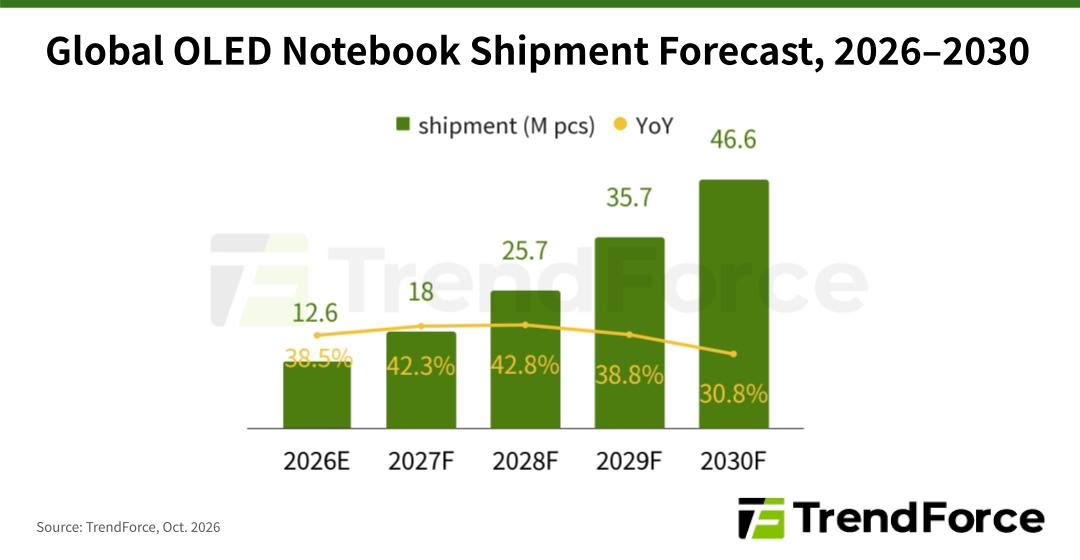
Key data: a shrinking notebook market, but a rising OLED segment
TrendForce's outlook provides a useful contrast. Even if the global notebook market is expected to shrink for two consecutive years, OLED notebook shipments may still grow against that trend. The implication for manufacturers and component suppliers is clear: category leadership may be decided by display technology migration rather than by total unit volume alone.
Apple's product transition can increase demand for OLED panels and accelerate technology upgrades across the industry chain, especially in higher resolution, lower power consumption and higher brightness research and development. That makes the MacBook Pro not just an end-product milestone, but a data point in a longer shift in notebook display specifications.
Supply-chain case: Samsung Display, the Asan campus and G8.6 capacity
On the panel supply side, Samsung Display is currently the exclusive OLED panel supplier for the new MacBook Pro. The company has designated the first phase of the A6 project at its Asan campus in South Korea as an Apple-specific facility on its Generation 6 and above large-format OLED line. In other words, the sixth-generation capacity line has been set aside for one strategic customer for the initial phase of a large-size OLED program.
This matters because the product is the first item to enter mass production on Samsung Display's G8.6-generation fine metal mask OLED line. Apple's selection of Samsung Display as the panel source for its first premium OLED notebook reflects Samsung's strength in advanced display technology and reinforces Samsung's competitive position in the premium OLED panel market.
The new MacBook Pro uses a tandem OLED structure and a pixel density of 254 pixels per inch, which places demanding requirements on panel manufacturing. Tandem OLED stacks multiple emission layers, which is expected to balance brightness, energy efficiency and panel lifespan. At the same time, the process is more complex, with higher expectations for material cost, production yield and process control.
Other panel suppliers are advancing qualification for related products, but Apple's strict technical specifications and Samsung Display's established supply advantage create a high entry barrier for competitors trying to join this chain. As a result, LG Display, BOE and TCL CSOT are directing more effort toward winning future panel orders for an OLED version of the MacBook Air, which is expected to launch in 2029.
Common misconceptions
- Launch volume equals immediate adoption. TrendForce's forecast for 1.2 million to 1.5 million units in 2027 is important, but the starting price of USD 2,899 and the coexistence with Mini-LED models may slow short-term replacement demand.
- OLED is automatically the better choice for every notebook. OLED offers better contrast, black level and response speed, yet cost, yield, brightness and lifespan requirements still determine where it can be adopted at scale.
- Apple's move creates the OLED notebook market. Lenovo, HP and ASUS were already bringing OLED into Windows notebooks before Apple's entry. Apple's arrival mainly raises visibility and strengthens supplier incentives.
- One flagship supply agreement closes the competitive field. Samsung Display currently leads the MacBook Pro OLED supply chain, but LG Display, BOE and TCL CSOT are pursuing qualification for future MacBook Air OLED orders expected in 2029.
Action recommendations for industrial decision makers
- Track capacity designation, not just product announcements. The decision to reserve the first phase of the A6 project at the Asan campus for Apple shows how large-format OLED capacity is being aligned to flagship notebook programs.
- Watch the qualification path for competing panel makers. Strict specifications, high pixel density and complex tandem manufacturing can delay supplier entry; the next test point is the expected 2029 MacBook Air OLED transition.
- Compare display technology by lifecycle constraints. For notebook planners, contrast, response and thinness must be evaluated alongside production cost, yield, brightness and lifespan, because those factors shape long-term sourcing viability.
- Use the MacBook Pro case to model premium-tier sourcing risk. Exclusive panel arrangements can reduce uncertainty for an OEM launch, but they also concentrate dependency on one supplier and one line architecture.
FAQ: what this shift means for notebook display supply chains
Q: What is the main display change in the new MacBook Pro?
A: Apple has introduced a PROLED XDR panel, making this MacBook Pro the first model in the MacBook product line to use a tandem OLED touch screen.
Q: How large is the expected shipment volume?
A: TrendForce forecasts 1.2 million to 1.5 million units for this new model in 2027.
Q: What are the short-term headwinds for the product?
A: The 14-inch version starts at USD 2,899, and the initial parallel sale of existing Mini-LED versions may suppress short-term replacement demand.
Q: Who led the OLED notebook market before Apple?
A: Windows-system brands including Lenovo, HP and ASUS had been expanding OLED notebooks across different price series before Apple's entry.
Q: Why is Samsung Display central to the supply story?
A: Samsung Display is the exclusive OLED panel supplier for the new MacBook Pro. The company has assigned the first phase of the A6 project at its Asan campus in South Korea to Apple on its Generation 6 and above large-format OLED line, and the product is the first mass-production item on the G8.6-generation FMM OLED line.
Q: What are competitors doing?
A: LG Display, BOE and TCL CSOT are working on related product qualification, but Apple's strict specifications and Samsung Display's supply advantage make entry difficult. These suppliers are focusing more on future MacBook Air OLED panel orders expected to arrive with a 2029 product.
Q: Does this mean OLED will replace LCD notebooks soon?
A: The material does not support a near-term complete replacement. OLED still faces cost, yield, brightness and lifespan constraints, but its penetration in notebooks can rise as capacity expands and technology matures.
Closing view
The PROLED XDR MacBook Pro is therefore a supply-chain event as much as a product launch. Apple's entry raises the strategic value of OLED notebooks, while the panel chain is being reshaped around capacity reservation, process maturity and long-term qualification. The next stage of competition will belong to suppliers that can balance cost, yield, display performance and volume delivery while serving the premium notebook programs now moving toward OLED.