
NAND Flash's Leverage Reversal: What Apple's Memory Cost Surge Means for the Industrial Supply Chain
Component pricing rarely reveals who holds power in a supply chain — until it moves. In memory, the move has been dramatic: flash chips that buyers spent years forcing to the lowest prices in the industry now sit at the centre of a demand race driven by AI data centres, and the suppliers that make them are collecting leverage they once did not have. The story of one smartphone buyer and the Japanese flash maker it squeezed is, for manufacturers and procurement teams, a case study in how fast a cost baseline can reset.
A rifle, an iPod and a sales executive's protest
Riding through a Southern California desert, Scott Nelson, a sales executive, stopped his dirt bike, pulled out a rifle and fired at his old iPod.
Nelson had spent years selling flash chips to Apple and still believed he had come away with the worse end of every deal. The Japanese manufacturer he represented, Kioxia, had almost no bargaining power. Apple — the world's largest flash buyer — used those chips inside the iPhone to store photos, music and applications, pressed its market position to extract every cent from suppliers, and made flash makers open their books so it could monitor sales and confirm that no other customer was getting a better price.
That imbalance is what Kioxia and other flash manufacturers never stopped resenting: Apple bought storage capacity cheaply and then sold it to consumers at many multiples of its cost. Nelson's frustration with the gap in bargaining power ran deep enough that he carried an Android phone to make the point.
How AI demand flipped the scale
Nelson kept the wreckage of that device — Apple's first flash-based product — and it now sits on his desk with a very different meaning. Research firm TechInsights reports that demand from AI hyperscale data centre operators has driven flash prices to five times their level over the past year, opening a new chapter for suppliers such as Kioxia.
Two years ago, TechInsights estimates, Apple was buying nearly twice as much flash capacity as Microsoft, Amazon, Meta and Google combined — four companies in total. Today, those hyperscalers together take twice the volume Apple does.
At the industry's largest conference, held this summer in Santa Clara, California, flash suppliers and their sales teams did not hide their enjoyment of what some privately called Apple's "karma". AI business has given Kioxia's sales executives and other flash vendors new leverage to charge Apple more.
This year, Meta, Microsoft and Amazon signed contracts with Kioxia that commit to higher prices in return for secure, long-term flash supply — and that also protect Kioxia's margins if conditions reverse. The company declined to comment.
Hyperscale buyers can absorb those prices. Relative to building an iPhone, flash represents a smaller share of a data centre's cost, and accounting rules allow them to spread that spend over future years.
Same bits, four times the bill
TechInsights estimates Apple's outlay on flash storage will reach $25 billion this year, against $6 billion in 2025 for roughly the same volume. Apple executive chairman Tim Cook has compared the climbing storage chip prices to a "once-in-a-hundred-year flood".
People familiar with the matter say Apple was caught flat-footed because its leadership had ignored warnings from analysts, certain it understood the market better than anyone. Flash sold for $68 per GB in 2005, fell to 5 cents per GB by 2023, and AI demand has now lifted it above 30 cents per GB — a 550% increase that threatens the high margins Apple earns on incremental storage.
| Period | Flash price per GB |
|---|---|
| 2005 | $68 |
| 2023 | 5 cents |
| Today | more than 30 cents |
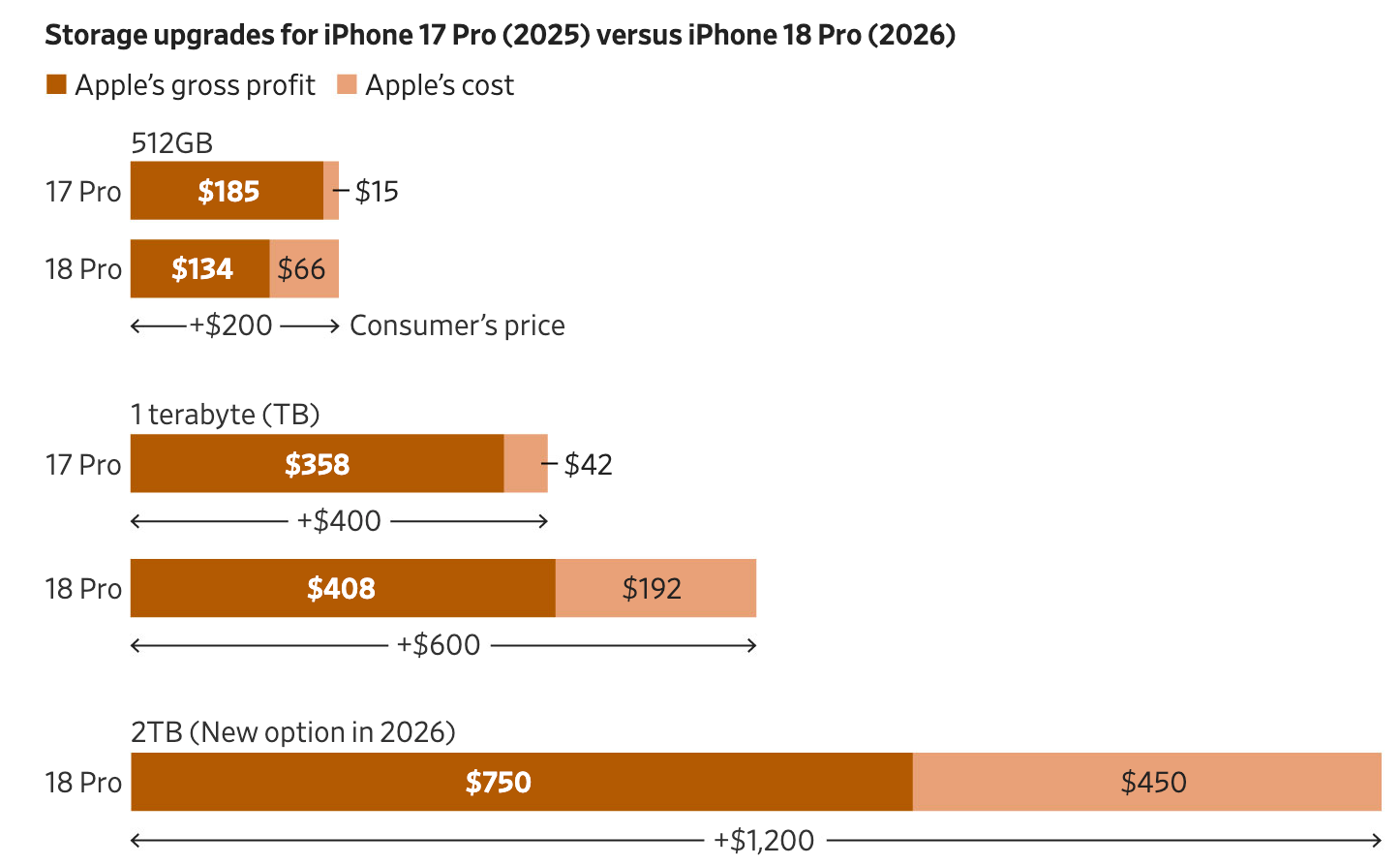
Last year, a buyer of the iPhone 17 Pro could pay $200 extra to double storage from the 256GB base. The Wall Street Journal's analysis found that block of additional capacity cost Apple $15 at the time; it is now $66.
The pressure shows up on both sides of the table
"Apple has always driven hard on price in front of its memory suppliers," said Walt Coon, an analyst at TechInsights. "Now that the balance of power has changed, the resentment suppliers carried is fully out in the open."
Apple responded in a statement: "For many years, we have maintained cooperative relationships with many suppliers, and the partnerships built over decades are invaluable to us. We look forward to continuing important collaboration with them in the future."
Where the margin came from — and where it is going
The Wall Street Journal found that from the debut of the iPhone and iPad through 2025, Apple earned more than 80 cents of gross profit on every $1 charged for additional storage — a margin above 80%. For Macs sold since 2010, the average gross margin has also been close to 80 cents per dollar.
In recent months Apple has raised prices on almost all of its products, with iPhone prices up an average of 13%, including older models that would normally be discounted.
The unresolved variables sit at both ends of the chain: whether consumers stretch the life of their iPhones rather than keep their usual upgrade rhythm, and whether, or when, Apple recovers its negotiating edge in flash.
"The relationship between Apple and the flash industry has always been love-hate," said Mark Newman, an analyst at Bernstein Research. For years Apple gave these manufacturers stable demand, and its power to push prices down served shareholders — but suppliers felt they had "been badly shortcharged".
How the dependency was built: from 5GB to the iPhone
In 2001, engineers at Kioxia — then Toshiba — showed two Apple executives a 1.8-inch diameter, 5GB hard drive they had developed, without knowing what it should be used for.
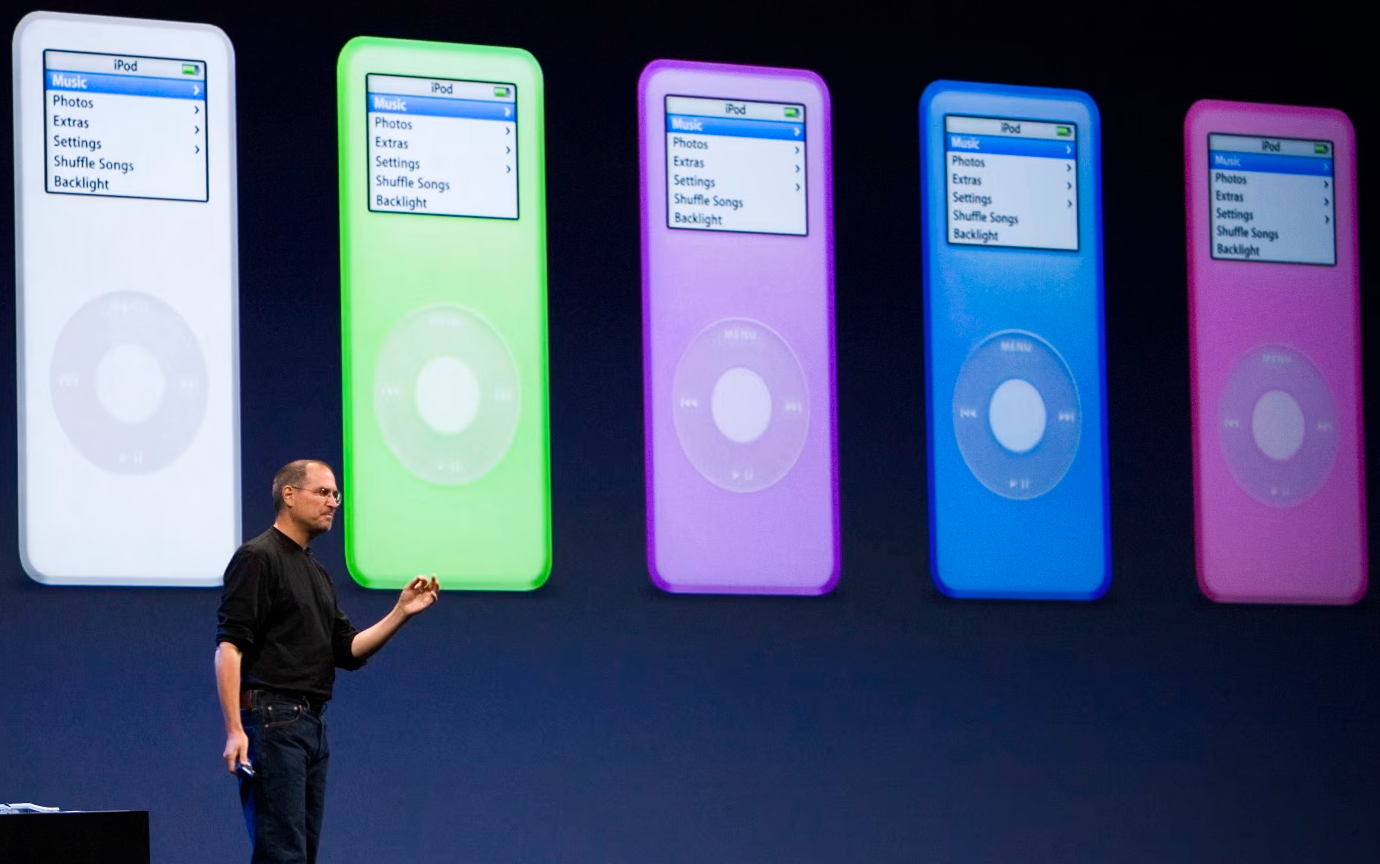
According to a person familiar with that meeting, the Apple executives immediately recognised a fit for a secret project and took exclusive rights to the small drive. It became the core of the iPod, one of Apple's blockbuster products.
Flash then moved data storage forward again. It proved better suited to consumer electronics than a disk drive with rotating platters and a tendency to fail: flash is a chip with no moving parts, smaller, higher in capacity and lower in power draw.
In 2005, Apple used flash to launch the iPod Nano, a music player thinner than a pencil, and prepaid $1.25 billion to lock in supply from five companies through 2010. Suppliers saw the opportunity and built more fabs. In June 2007, Apple released the flash-based iPhone and reshaped the consumer electronics industry.
As the iPhone took off, Apple came to absorb more than one-fifth of the global flash supply, spending an estimated $3 billion to $4 billion every year and becoming the world's largest flash buyer, according to TechInsights.
The negotiation machine: audits, "most favored customer", no commitments
That demand only strengthened Apple's position. Suppliers accepted its terms and pushed its prices to the lowest level in the industry, while also benefiting from Apple's large orders, because chip fabrication carries extremely high fixed costs and fabs must run at capacity to make money.
Apple's second hardball move was refusing to commit. After ordering at very low prices, it sometimes declined shipments when flash prices fell, leaving suppliers with stockpiles of unsold chips — including products customised for Apple. Kioxia executives joked that they felt like Charlie Brown, the American comic strip character, winding up to kick the football while Lucy yanks it away at the last moment.
Those standoffs usually ended the same way: suppliers cutting Apple's price again.
The key figure behind the strategy was Tony Blevins, who led Apple's procurement function and earned the nickname "the Blevins Terminator" for negotiation tactics some called skilful and others called cold.

Sessions run past midnight
Blevins left Apple in 2022. He would book suppliers into consecutive negotiation sessions, letting competing sales teams run into each other and sharpening the pressure. Sales representatives learned to carry energy bars to get through meetings that Apple executives sometimes extended past midnight, occasionally without even a dinner break.
His reputation for playing bad cop became leverage in itself: if contract terms missed what they wanted, his team would threaten to bring in Blevins.
One important clause gave Apple the right to audit suppliers' accounts. Flash makers generally had to record Apple as the "most favored customer", ensuring no other buyer received a lower price, and Apple audited to verify that.
People familiar with the agreements said that more than a decade ago Apple found that Micron had sold flash to another customer at a lower price, and later won a settlement of tens of millions of dollars through arbitration. Audits ran so frequently that Blevins negotiated a volume discount with the auditing firm Deloitte.
Those audits also gave the iPhone maker first-hand visibility into flash suppliers' operations, including the output of various machines on the factory floor — information its negotiators used to gauge how badly each supplier needed a large order.
IDC estimates that roughly 100 million iPhone users paid extra last year to expand storage so they could keep HD video, downloaded content, message attachments and data-heavy apps. Many spent $200 to add 256GB; others spent as much as $800 to add 1.75TB. Applying an 85% profit margin, The Wall Street Journal's analysis puts that business at more than $10 billion in gross profit. Mac and iPad customers upgrade capacity too, contributing billions more, and Apple charges for iCloud storage by the month when devices run out of space.
Two attempts to change the outcome
For years, flash suppliers tried to win the upper hand at the negotiating table.
Around the end of 2015, flash maker SanDisk refused Apple's request for additional supply because other customers were already willing to pay more. A person familiar with that phone call said Blevins threatened retaliation against a SanDisk salesperson, vowing he would make SanDisk CEO Sanjay Mehrotra "crawl back on his knees and beg Apple".
Around 2017, with flash supply tightening, Western Digital — SanDisk's new owner — asked Apple Pay for a fee to reserve flash chips, without committing to sell Apple anything. Blevins was furious. He wrote the date on the whiteboard in his office, circled it deliberately and sent the photo to Western Digital executive Mike Cordano, promising he would settle the score later.
A year later, flash prices fell and Blevins had his opening. Cordano and colleague Jerry Kagele arrived with a refund check hoping to repair the relationship; Blevins told them they must never charge a reservation fee again, they agreed, and the two sides closed the matter with a handshake.
As a penalty, Blevins told the pair that if Western Digital wanted Apple to buy its flash chips, it would have to pay Apple to test them — and Apple still would be under no obligation to buy anything. He then had Apple security escort the two men out of the office.
The industry's low point came in 2023. As the pandemic-era work-from-home device boom faded, flash fell to just 5 cents per GB. Bernstein Research estimated the flash industry's operating losses that year at $19 billion, while Apple booked $14 billion in gross margin from selling additional flash capacity alone.
Nelson described those days as brutal: "I hope we never have to go through that period again."
Three common misreadings of this cycle
- Reading the reversal as one company's luck. The leverage moved because the demand base moved: TechInsights' figures show Microsoft, Amazon, Meta and Google going from roughly half of Apple's flash volume two years ago to twice Apple's today. A buyer concentrated in one product line loses ground the moment another buyer class outbids it.
- Assuming cheap components equal a healthy cost position. Flash at 5 cents per GB in 2023 looked like a permanent win for buyers, yet the same industry ran $19 billion of operating losses that year — a signal that capacity, pricing discipline and demand depth were all under stress.
- Treating unit price as the only contract variable. The deals Meta, Microsoft and Amazon signed with Kioxia combine higher price with long-term supply security and margin protection if the market turns; programmes optimised only on unit cost do not get that second layer.
What procurement and operations leaders can take from it
- Re-baseline memory assumptions. Any plan still priced off the 2023 trough is out of date: per-GB cost has run from 5 cents to more than 30 cents, a 550% move.
- Stop treating buyer-side protections as permanent. Audit rights, "most favored customer" clauses and refusal to commit all worked — and all were tolerable to suppliers only while volume and fab utilisation depended on one large customer.
- Apply the cost-share test. Hyperscale operators pay more for flash because it is a smaller share of their build and can be spread over future years. Run the same arithmetic across your own bill of materials before conceding volume elsewhere.
- Track demand-side feedback. The live risk in this cycle is consumer behaviour: with iPhone prices up an average of 13%, longer device lifespans would soften demand and could hand bargaining power back.
- Put commitments in writing. Reservation fees, declined deliveries and testing-payment demands recur throughout this history; clarity on volume, delivery and reserved capacity is exactly what both sides fought over.
FAQ
Why did flash prices rise so quickly?
AI hyperscale data centre demand, which TechInsights says lifted prices to five times their level over the past year, with those operators now buying twice the flash volume Apple does.
Why does the increase hurt a device maker more than a cloud operator?
Flash takes a larger share of a smartphone build than of a data centre build, and accounting rules let cloud operators spread the cost over future years. On the iPhone 17 Pro, the $200 upgrade that doubled 256GB storage went from a $15 input cost to $66.
How much is Apple now spending on flash?
TechInsights estimates $25 billion this year, against $6 billion in 2025 for roughly the same quantity. Tim Cook has compared the price run-up to a "once-in-a-hundred-year flood".
Did suppliers ever have leverage?
Only briefly. SanDisk's refusal to add supply around the end of 2015, and Western Digital's reservation-fee demand around 2017, were both answered by Apple after prices fell in the following year.
What has Apple said publicly?
That it has maintained cooperative relationships with many suppliers for many years, values the partnerships built over decades, and expects to continue important collaboration with them in the future.
For industrial readers, the memory market's reversal is a reminder that bargaining power is a condition of the market rather than a permanent property of the largest buyer. Everything Apple built through audits, pricing clauses and refusal to commit was real — and reversible the moment a new class of customer arrived willing to pay more for certainty. The same arithmetic will apply well beyond smartphones the next time a component's demand base shifts. WorldIndustrialWeekly will keep following how such repricings reach the shop floor, the project estimate and the procurement desk.