
AI Is Repricing Semiconductor Lifecycles: What Long-Life Industrial Teams Must Plan Now
For WorldIndustrialWeekly readers, the most consequential semiconductor signal from the AI build-out may not be a new accelerator board. It is the reallocation of memory manufacturing attention. As capacity and investment tilt toward DDR5, GDDR6, HBM3 and LPDDR5, some DDR3 and DDR4 parts embedded in long-lived industrial, aerospace, defense, transportation and medical programs can face tighter availability and earlier end-of-life notices than their design teams had assumed. This changes the practical question for engineers from “Can we buy it today?” to “How will we keep a qualified system functioning across its expected service life?”
Why a Memory Shift Becomes a Lifecycle Problem
The core risk is asymmetry. The system may need to operate for decades, while the semiconductor generation inside it has a much shorter commercial runway. A part can remain technically appropriate for an application after its maker no longer finds it commercially attractive. In validated products, a change is rarely a simple swap: testing, requalification and recertification can follow, raising cost and schedule exposure.
That asymmetry turns obsolescence into a portfolio-management issue. Teams cannot assume that all components age on the same schedule. A low-complexity part may be replaceable with minimal disruption, whereas a highly integrated or difficult-to-qualify part can create ripple effects across hardware, software, documentation and certification.
Key Data Reference: What the Source Facts Tell Us
No sales claim or single-vendor metric is required to understand the exposure. The evidence in the material is categorical and structural:
- AI-oriented memory investment is concentrated on DDR5, GDDR6, HBM3 and LPDDR5.
- DDR3, DDR4 and other legacy technologies remain in long-life systems.
- Long-life sectors include aerospace, defense, transportation, industrial and medical products.
- Support horizons can extend 10, 15 or 20 years, which may make a one-time last buy difficult because of capital, storage, inventory management and changing demand.
- Full traceability to the original manufacturer matters, and the text cites SAE AS6496 as the standard associated with authorized distribution practices.
These facts define the planning frame: the pressure is a supply-ecosystem shift, not an isolated shortage of one processor type.
Case View: How One Legacy Memory Decision Can Cascade
Consider a long-life program that uses memory qualified by its architecture rather than only by nominal capacity. The original design may have been approved around a specific data width, speed, temperature range, package, die configuration or other characteristics. If a later project asks for “the same capacity” but a different device configuration, it may still trigger architectural review and qualification work.
The case becomes more acute when an end-of-life notice arrives earlier than expected. An engineering team might then confront three constrained choices: secure enough inventory to sustain future production and service, redesign around a replacement device, or attempt to maintain the original design without a reliable long-term supply path. Each option carries technical, financial and certification consequences.
This is why the discussion should include lifecycle specialists who can see both sides of the problem. In the source material, Rochester Electronics is described as operating across authorized distribution and licensed manufacturing. Where authorized finished devices are available, those devices can support continued use. Where finished devices are no longer available, authorized wafer and die can enable licensed manufacturing for selected legacy devices. Rochester Electronics technical staff may also work with customers and local sales teams to review bills of materials, timelines and component lifetimes, sometimes at single-device level and sometimes across hundreds of line items.
Common Misconceptions That Weaken Lifecycle Planning
| Misconception | What to replace it with |
|---|---|
| Obsolescence is mainly a procurement alert triggered by processors, microcontrollers or FPGAs. | It is a whole-ecosystem issue. Memory and supporting devices can matter just as much for long-term availability. |
| A replacement part with the same capacity is automatically interchangeable. | Interchangeability depends on data width, speed, temperature range, package, die configuration and other parameters, plus qualification context. |
| A last-time buy solves any long-life program. | For 10, 15 or 20-year support needs, inventory size, capital, storage, management and changing demand may make a single buy impractical. |
| Gray-market inventory is an acceptable backup when authorized channels are inconvenient. | For high-reliability and safety-critical systems, independent and gray-market sellers can introduce counterfeit, recycled or poorly stored device risks; traceability to the original manufacturer is the safer criterion. |
| Lifecycle work starts when an end-of-life notice lands. | Earlier visibility preserves more options, including inventory planning, continued authorized manufacturing, redesign or a combination of approaches. |
Action Recommendations: A Resilient Planning Loop
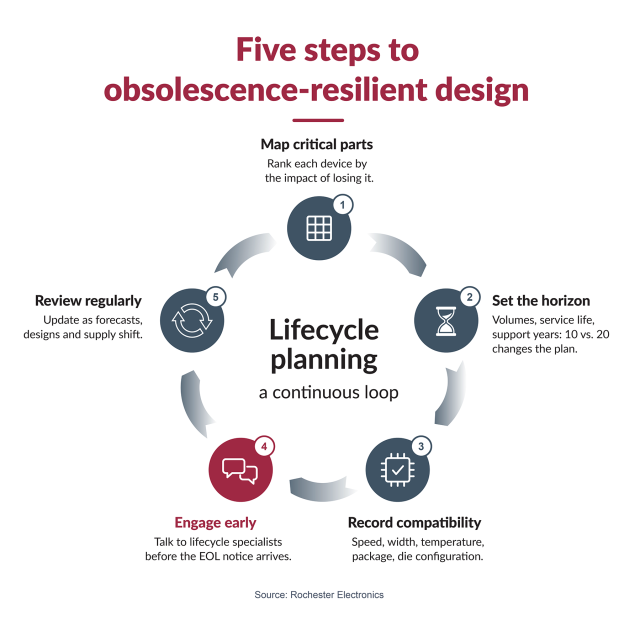
- Rank parts by impact, not by familiarity. Build a critical-parts matrix that records the role of each device and the potential consequence of redesign or replacement.
- Start with the program, not the component notice. Define expected production volumes, service-life requirements, installed-base support and the support horizon.
- Document compatibility in the product lifecycle record. For memory and similar devices, capture speed, width, temperature, package, die configuration and other characteristics that determine whether a substitute is truly acceptable.
- Use authorized channels as a control mechanism. Prefer full traceability to the original manufacturer, with Rochester Electronics cited in the source material as an example of a distributor and licensed manufacturing partner operating under authorized supply practices such as SAE AS6496.
- Open technical dialogue early. Have semiconductor and lifecycle specialists review bills of materials, program timelines and component lifetimes before decisions become constrained.
- Review the plan regularly. Forecast changes, design revisions and supply-chain developments should update the lifecycle strategy rather than make it a static document.
FAQ: Turning Lifecycle Risk Into Manageable Tasks
Question: Does AI demand create immediate shortages for every DDR3 or DDR4 device?
Answer: No. The source material describes a risk pattern: as investment moves toward AI-oriented memory, certain DDR3 and DDR4 devices used in long-life systems may face tighter supply and earlier end-of-life notices. The effect is uneven and depends on the device, the program, and how much lifecycle visibility the team has.
Question: Why does memory substitution need more than density matching?
Answer: A qualified design may depend on characteristics such as data width, speed, temperature range, package and die configuration. Even a higher-capacity option can require assessment if the original qualification was tied to a specific device configuration.
Question: When should an engineering team begin lifecycle planning?
Answer: Before an end-of-life notice becomes urgent. Early engagement preserves more options, including continued authorized manufacturing, inventory planning, redesign, or combinations of approaches.
Question: What is the safest procurement position when a part is discontinued?
Answer: Buy from authorized sources with traceability to the original manufacturer. The source material warns that discontinuation can create opportunities for independent and gray-market sellers and raises counterfeit, recycled or poor-storage risks for critical systems.
Conclusion: Manage What Cannot Be Fully Eliminated
Obsolescence in semiconductor devices is a normal feature of technology cycles. What is not inevitable is disruption. A program that understands criticality, records compatibility constraints, plans against its real service horizon, maintains authorized supply relationships, and keeps dialogue open across engineering and lifecycle expertise is better positioned when older memory generations are affected by AI-driven investment shifts.