
WorldIndustrialWeekly General Guide: Operating Through the AI Memory and Chip Sales Supercycle
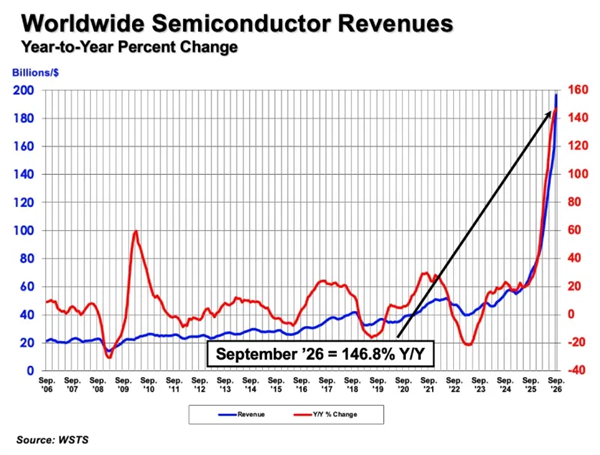
The September figures answer the question simply: AI compute and memory demand are driving a synchronized semiconductor rally that industrial operators can no longer treat as background noise. The short answer is that chip sales are rising because HBM, DDR5 and related memory are being pulled into AI server builds faster than capacity, pricing and allocation can absorb; the longer story below turns those numbers into procurement, planning and risk decisions for WorldIndustrialWeekly readers.
By Michael Torres for WorldIndustrialWeekly. For Industrial Weekly readers in manufacturing, automation, energy, materials, supply-chain and engineering roles, the question is not whether chip sales rose in September. The question is what that increase means for orders, inventory policy, BOM stability, plant expansion and capital allocation.
What did the September chip-sales data reveal?
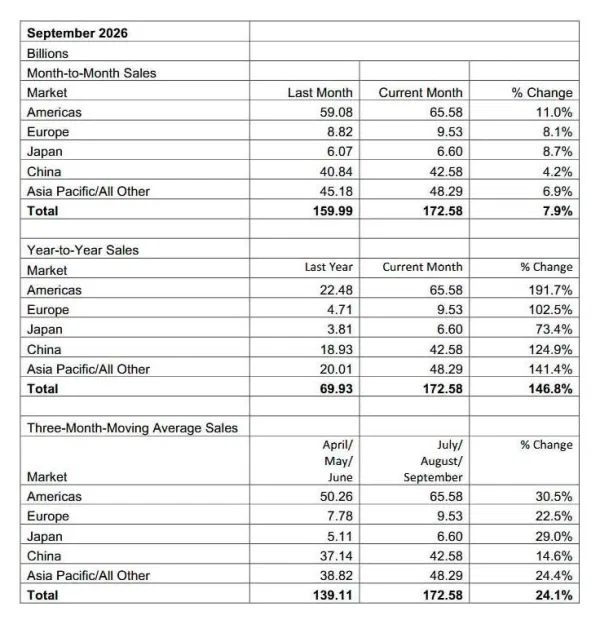
Conclusion first: September marked a synchronized regional expansion, not a narrow data-center spike. The figures show that AI compute demand and memory tightness are converting into measurable revenue across all major semiconductor markets.
| Region | Year-over-year sales increase in September |
|---|---|
| Americas | 191.7% |
| Asia Pacific and other regions | 141.4% |
| China | 124.9% |
| Europe | 102.5% |
| Japan | 73.4% |
The table captures the breadth of the cycle. SIA president and CEO Michael Robbins said global semiconductor sales recorded strong third-quarter growth and were up more than 20% sequentially for the third consecutive quarter, while all major regions showed robust year-over-year demand. He also emphasized that AI infrastructure investment had not shown signs of slowing, making it likely that the cycle will extend into 2027.
Public SIA data from the same reporting period adds further scale: September sales were reported at $172.6 billion, while Q3 2026 global semiconductor sales were reported at $517.7 billion. See the SIA market-data page for the broader reporting context.
Why AI servers and memory are turning demand into hard bookings
Conclusion first: AI changes the semiconductor cycle because high-bandwidth memory and server-class DRAM are no longer ordinary components. They are bottleneck inputs that shape project timing, factory throughput and final-product margins.
Omdia projected that Q3 2026 global semiconductor revenue would exceed $500 billion and that the first three quarters of 2026 would generate more than 50% of the full-year 2025 total. This is why the market is not reading these numbers as a one-month statistical bounce.
Goldman Sachs research cited in industry analyses estimated 2026 undersupply levels of 4.9% for DRAM, 4.2% for NAND and 5.1% for HBM, the highest gaps since 2011. When supply gaps reach that scale, pricing power shifts from buyers to producers.
SK hynix and Micron publicly announced that all 2026 HBM capacity was sold out, and some customers were beginning to lock supply for 2027 to 2028. The practical effect is a seller's market: AI compute demand becomes contracted revenue, and memory makers gain control over how much general-purpose supply reaches the open market.
Case lens: AI server memory bookings. The core fact remains that 2026 HBM capacity was sold out and some buyers were moving toward 2027 to 2028 allocations. Later industry coverage adds a sharper operational note: SK hynix reportedly signed long-term agreements covering more than half of its 2027 and 2028 production capacity, according to industry analysis. For operations teams, this matters because sold-out capacity does not simply mean higher prices. It affects project launch dates, service-level agreements, product qualification and the credibility of customer promises.
WorldIndustrialWeekly analysis: If capacity is already allocated years out, the next competitive question for industrial buyers is not whether to buy chips, but how to secure them, qualify substitutes and communicate delivery risk without eroding margin.
What this means for plant operations and procurement
For factory managers and procurement leaders, a chip-sales surge is a scheduling, inventory and risk event. The following areas deserve special attention.
- Memory-heavy products are most exposed. AI servers, edge gateways, vision controllers, robotics PCs, power-management modules and any platform using DDR5 or high-density NAND should be re-forecast as constrained SKUs, not commodity parts.
- Allocation is now more valuable than spot access. Altium sourcing guidance says allocation-only ordering is becoming common, which means contracted volume corridors can outweigh headline unit prices.
- BOM flexibility becomes a competitive requirement. Design teams should identify alternate memory grades, controller families and board layouts early; late substitution often fails during qualification.
- Capital planning must match cycle lead times. Expanding capacity is not a short-term procurement lever. Analysts tracking the cycle expect strong conditions through 2027, with potential volatility later if new capacity arrives after demand normalizes.
WorldIndustrialWeekly suggests treating the September surge as an operational warning: the market may be growing, but not every product, customer and factory line will benefit at the same pace.
Common pitfalls: where managers misread the AI memory supercycle
Even when the direction is obvious, the operational interpretation often fails. The most common mistakes are:
- Treating 191.7% Americas growth and 124.9% China growth as uniform demand. Regional rates reveal where spending is strongest, not whether every customer or product line will behave the same.
- Assuming sold-out HBM only means higher prices. It also means delivery windows, priority queues, contractual penalties and qualification delays.
- Overbuying spot inventory to protect one project. Spot purchases can create obsolescence, tariff or platform risk if a product changes in 2027.
- Ignoring the 20% sequential growth signal in the third quarter. Consecutive third-quarter expansion beyond 20% shows structural tightness, not a temporary inventory correction.
Step-by-step action guide for 2026 planning
WorldIndustrialWeekly suggests the following operational checklist for teams preparing for the next two years:
- Map SKUs by memory intensity and AI exposure. Separate HBM, DDR5, general NAND and commodity logic. Assign each SKU to green, yellow or red supply risk.
- Re-run 12- and 24-month demand plans with allocation assumptions. Use Omdia's Q3 2026 revenue forecast above $500 billion and the Goldman Sachs supply-gap estimates as stress cases, not base cases only.
- Move from price negotiation to capacity negotiation. Ask suppliers for committed corridors, substitution rights, priority rules and cancellation windows before the next design freeze.
- Open a design flexibility register. Track alternate memory controllers, form factors, thermal solutions and validated firmware paths. A usable substitution list is often more valuable than a small unit-price gain.
- Set a customer-communication protocol. If a chip-sales surge translates into delivery uncertainty, sales and engineering must issue consistent lead-time ranges, not ad hoc promises.
- Review capital and inventory policy. Contracted inventory can stabilize production, but excessive stock can become a liability if demand shifts faster than the semiconductor cycle.
FAQs for industrial and engineering decision-makers
Is the September surge only about AI data centers?
No. The September table includes Americas, Asia Pacific and other regions, China, Europe and Japan, and SIA described all major regional markets as strong. AI is the engine, but the demand has broadened into infrastructure, devices and industrial systems that rely on memory and logic.
Should procurement act before demand slows?
Usually yes, because memory contracts and fab scheduling move earlier than order books. SK hynix and Micron already reported 2026 HBM capacity sold out, with some customers locking supply into 2027 to 2028. Waiting until order books tighten can reduce bargaining power.
What is the biggest operational risk between 2026 and 2028?
The biggest risk is mismatch between demand visibility and capacity visibility. A company may see AI-led growth and order aggressively, while memory allocation and product substitution create late-stage constraints. A second risk is overbuilding against a cycle that analysts describe as strong through 2027, with possible volatility into 2028.
Reference sources
- SIA market data and monthly semiconductor sales reports
- Omdia semiconductor revenue release via Business Wire China
- Memory shortage analysis citing Goldman Sachs DRAM, NAND and HBM undersupply estimates
- Altium Resources: memory market shift, shortages and allocation
- Blocks and Files: memory semiconductor supercycle through 2028
WorldIndustrialWeekly is published by Industrial Weekly. Contact: news@industrialweekly.com