
Printed in Austin, Engineered in Amsterdam: A Practitioner’s Playbook for Aectual’s Caracol Production Network
Aectual’s print floor in Amsterdam has been the single place its recycled-material, large-format 3D printed panels were made — one node serving clients in 45 countries. That changes now. Aectual’s products are being put onto Caracol’s robotic large-format additive manufacturing (LFAM) partner network, starting with a Houston project printed at Caracol’s Austin headquarters, while design, quality, warranty and take-back remain with Aectual. Below is how I would qualify that second source.
Read it as a plant problem, not an announcement. This is process transfer: a recipe proven over years of continuous production moves to another machine, in another country, under another operator’s hands, and the buyer is expected to notice nothing. My view, offered as analysis rather than company language: the printer is the easy part. Feedstock lots, parameter transfer and whose name sits on the quality record decide the outcome.
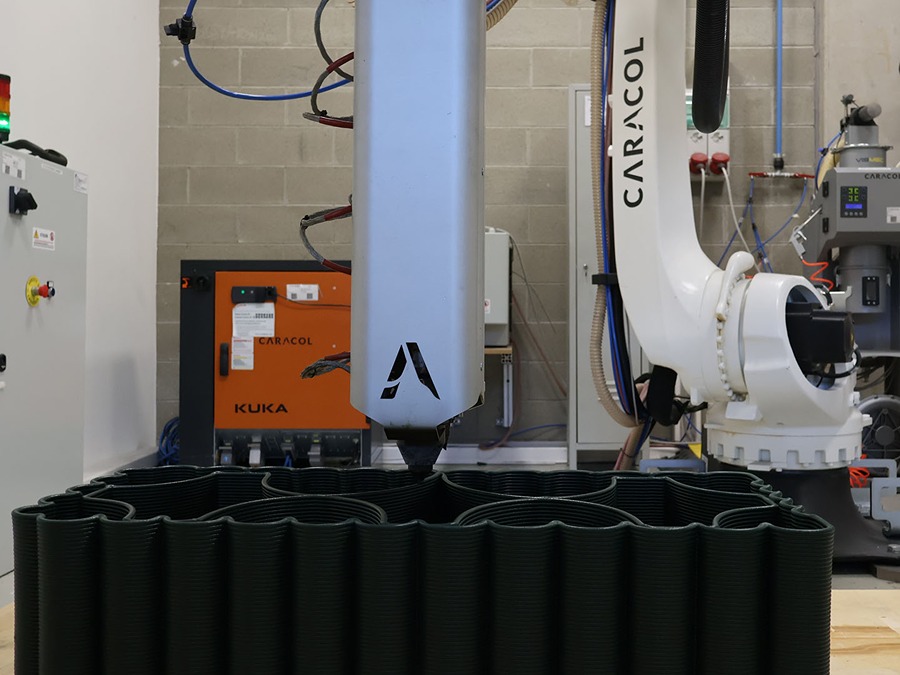
What actually changed on the production side
Not the product. Aectual’s panels and interior elements are printed on demand from recycled materials at architectural scale, can be collected and reprinted into new products, and are specified by international brands for commercial interiors, workplaces above all. What changed is where capacity sits: through Caracol’s global network of specialised manufacturing partners, Aectual reaches local production capacity around the world and adds that capacity without building its own factories, while the product and production intelligence stays inside Aectual’s platform.
In plant terms, The United States is the first market. The opening job is Aectual’s Origami Curve ceiling system for a commercial project in Houston, already in production at Caracol’s Austin headquarters. Amsterdam is the working blueprint: Aectual’s products, process standards and quality checks are deployed onto parts built with Caracol’s systems, so a product made in Austin matches one made in Amsterdam. The roadmap then runs through Caracol’s network into the Middle East, Asia and beyond.
Why a second node now — three dated reference points
Demand shape explains the timing. Aectual’s client base is overwhelmingly corporate, with business customers reported at around 95% of clients, and corporate fit-outs refresh on roughly a five-year cycle. Repeat, multi-site volume is the only demand profile that amortises a distributed print network; a one-off feature wall does not.
Two external markers belong in the file. The World Economic Forum named Aectual among the 2026 innovators of its UpLink Low-Carbon and Circular Systems Challenge, a cohort the Forum published on 23 September 2026. On the supply side, reporting on Caracol’s Austin expansion in September 2025 put the facility’s assembly capacity at up to 100 robotic LFAM systems per year, with an applications centre attached.
The carbon case deserves careful handling. Aectual has stated publicly that printing these products can reduce CO2 emissions by around 80% against conventional routes, because less material is used, nothing sits in inventory and output is made to order. Treat that as a make-to-order argument at product level, not a measured average for your job — ask for project-specific numbers.
The transfer step by step: what to require from either partner
- Freeze the specification at drawing level. Dimensions, flatness tolerance, edge and bracket detail, a colour master panel, and the fire-performance documentation that applies to the exact build rather than the product family.
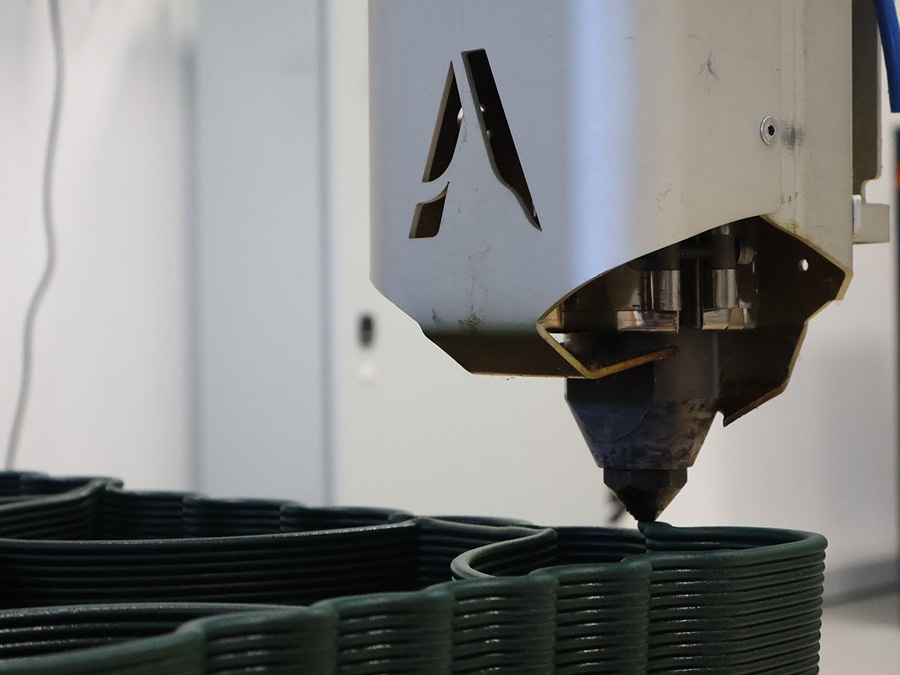
- Qualify feedstock lot by lot. Caracol’s Heron AM platform is pellet-fed, working through fused granulate fabrication (FGF). That is precisely why post-consumer plastic can be an input at all — and why melt-flow index, moisture, contamination and colourant history drift between lots. Record melt-flow index, moisture content and colour history per lot and keep the lot traceable to the finished panel. Aectual’s co-founder and chief commercial officer, Hedwig Heinsman, has put the constraint plainly: waste plastic has real material advantages, but the company needs large volumes from a single source, which is why it seeks manufacturing partners that can close the loop. If you are pricing circular resin against virgin feedstock, our breakdown of how Europe’s plastics buyers should price the feedstock trade-off is the companion read.
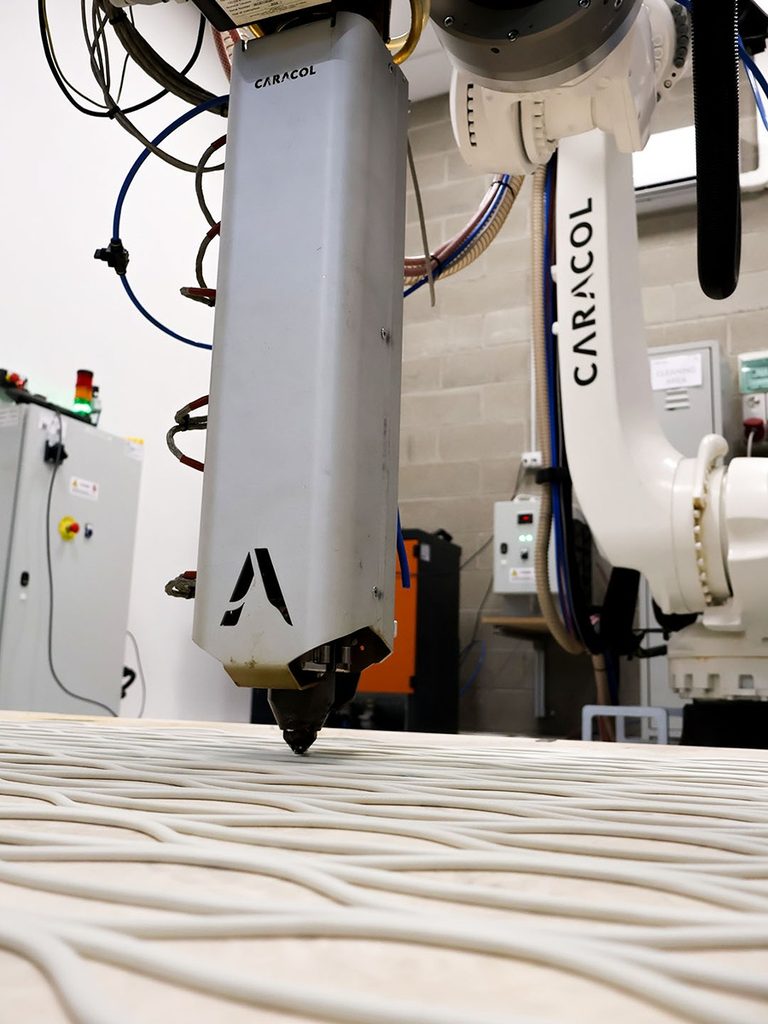
- Transfer parameters, not just files. Layer height, bead width, print speed, thermal management and path strategy have to travel with the geometry. Two identical robots running different parameters do not produce the same panel. Caracol’s platforms pair commodity six-axis robot arms with in-house extrusion and software, so the process stack, not the arm, is what you are buying — a point underlined in the vendor’s own platform description and in a company profile by MIT Technology Review China (mittrchina.com).
- Run coupons and a first article before the order. Mechanical coupons, colour difference read against the Amsterdam master panel, and one full-size reference piece to prove seam and bracket fit.
- Confirm finishing and site interface at the print node. Trimming, drilling, bracket positions and how panels meet the substrate. On large printed interiors, most punch-list items land here rather than in the printing itself.
- Write accountability down. Under this arrangement Aectual remains its clients’ single point of contact and stays responsible for design, quality, warranty and take-back wherever a product is made. That clause is the template to demand from any networked supplier.
- Close the take-back loop operationally. Collection point, minimum return volume and the reprocessing route. Without those three, circularity is a line on an invoice.
Numbers to hold the network to
| What you measure | Why it decides the outcome | Reference point on file |
|---|---|---|
| First-article pass rate at the new node | Whether the Amsterdam recipe genuinely transferred | Aectual’s process standards and quality checks extended to parts built on Caracol’s systems |
| Colour and geometry drift per feedstock lot | Recycled granulate varies, and interiors are read from two metres, not from a sample card | Single-source volumes needed for stable colour, per Aectual’s own account |
| Node lead time versus ocean freight | The commercial case for printing near demand | Houston project printed at Caracol’s Austin headquarters |
| Machine supply headroom | Systems assembled per year is not panels delivered per year | Up to 100 robotic LFAM systems per year planned at Austin (2025 reporting) |
| Warranty and take-back owner | Whether you have one counterparty or three | Aectual retains design, quality, warranty and take-back |
| Independent verification | Ask for the quality dossier face to face | Formnext in Frankfurt, 17 to 20 November 2026, booth C129, Hall 12.1 |
That Austin figure needs a caution attached. Assembling up to 100 robotic LFAM systems a year is machine-building capacity; qualified architectural output depends on the process, feedstock and sign-off gates above. If a supplier says a node “has capacity”, ask which of those three gates it has cleared. The same distinction applies to other regional capacity announcements in the same trade, including the two new metal AM sites in California and Connecticut.
Six failure modes to expect on the first orders
- Colour and bead-weld variation lot to lot, discovered at handover instead of at coupon stage.
- Warpage and residual stress across long beads on wide panels; damp recycled granulate is the first suspect.
- A node holding the machine but not the parameter set, producing panels that look right and do not seam.
- Certification drift: a fire-performance dossier written for one formulation does not automatically follow a second source.
- Buying capacity by nameplate, counting a plant as a node before qualification — the trap in most distributed-production announcements.
- Take-back without collection economics, which turns a circular promise into landfill with good intentions.
Who this model fits — and who should stay with a single factory
It fits multi-site corporate programmes on a five-year refresh cycle, panels large enough that freight dominates both cost and schedule, buyers who want one warranty owner, and designers who can specify inside recycled-material variance. It does not fit single rooms and small volumes, clients who cannot accept any colour variance, or a job where the “local” node is still unqualified and the deadline is measured in weeks.
Expect the network argument to widen. Caracol’s platform family spans polymer and composite pellet extrusion (Heron AM) plus a robot-arm metal line (Vipra, built on wire arc additive manufacturing, WAAM, a form of directed energy deposition), and the Austin facility covers polymer and metal LFAM. Its published case work already includes THE CAB, a single-piece recreational-vehicle shell printed from recycled polymer, announced in November 2025, and market reporting has tracked Caracol promoting reconfigurable microfactories sited near demand at IMTS in September 2026 (Astute Analytica). For Aectual clients, that breadth matters only where the scope is architectural panels; for facilities teams it signals that the same nodes may later serve tooling and structural parts too.
FAQ: the questions buyers ask first
Is a panel printed through Caracol’s network identical to one printed in Amsterdam?
That is the design intent: Aectual’s products, process standards and quality checks are deployed onto parts built with Caracol’s systems, so a product made in Austin matches one made in Amsterdam. Identical on paper is not identical on site, which is why coupons, a colour master and a first article belong in your contract.
Does local production make the product cheaper?
No public price data exists for either node, so any cost claim is inference. The savings logic sits in freight, lead time, packaging damage and inventory, not in machine hourly rates. My recommendation: price against landed cost and schedule risk, not against a printed unit rate.
If a Houston installation goes wrong, who do I pursue?
Aectual remains the single point of contact and carries design, quality, warranty and take-back regardless of which partner prints the part. Confirm in writing that this holds in every region on the roadmap, not just the first one.
What recycled content should I specify?
Specify it as a range with lot evidence attached, not as a single headline percentage. Recycled feedstock is lot-variable, and the practical constraint is securing large volumes from a single source.
Where can I inspect both companies before committing?
Formnext in Frankfurt, 17 to 20 November 2026, at booth C129, Hall 12.1, where the two are showing their combined capabilities together.
A framework you can copy: four gates
Gate 1, specification: drawings, tolerances, colour master and the documentation for the exact build. Gate 2, feedstock: lot-by-lot data on recycled granulate, with traceability from lot to panel. Gate 3, process parity: parameter transfer plus coupons, first article and a full-size reference piece. Gate 4, accountability: one named owner for warranty, take-back and production data. A supplier that clears all four in writing has sold you lead time and freight resilience; one that clears only the first has sold you a machine and called it capacity.
Sources consulted
- World Economic Forum, UpLink Low-Carbon and Circular Systems Challenge cohort story, published 23 September 2026 — weforum.org
- 3D Printing Industry, “Caracol expands US footprint with new Austin facility for polymer and metal LFAM”, September 2025 — 3dprintingindustry.com
- Caracol AM, Heron AM platform page and “What is robotic LFAM 3D printing?” knowledge-hub article — caracol-am.com
- Caracol AM case study, THE CAB recycled-polymer RV shell — caracol-am.com
- Aectual co-founder Hedwig Heinsman on recycled feedstock volumes and corporate refresh cycles, in company material carried at tetrapak.com
- Astute Analytica, Micro-Factory and Distributed Manufacturing Market report, on Caracol’s microfactory push at IMTS 2026 — astuteanalytica.com
- MIT Technology Review China profile of Caracol’s Heron and Vipra platforms and turnkey model — mittrchina.com
- 3Dprinting.com, Aectual–Caracol partnership coverage, 11 November 2026 — 3dprinting.com