
How ABLIC Keeps Growing in a Flat Analog Market: Medical Ultrasound, AI Data Centers and Battery-less Leak Sensors
WorldIndustrialWeekly · Industrial analysis desk · Michael Torres · Contact: news@industrialweekly.com
ABLIC kept expanding from 2023 to 2025 despite a flat analog semiconductor market, reporting over 10% year-over-year sales growth in FY 2025. Satoshi Hanazawa, ABLIC’s Director, Senior Vice President, and CPO, says the result came from five key sectors built on low-power technology refined over more than half a century, with medical ultrasound, AI-linked infrastructure, and battery-less leak sensing pulling the most attention.
Why did ABLIC grow while analog demand stayed flat?
The short answer, from Hanazawa's account, is focus. ABLIC frames its business around lithium-ion battery protection, automotive power management ICs, medical and high-voltage applications, magnetic and temperature sensors, and battery-less water leak sensors. It is not trying to win every analog socket; it is trying to be the first choice where customers need low power, reliability, and long qualification cycles. That positioning matters because, after the pandemic-era inventory correction, the analog market remained broadly flat from 2023 to 2025. ABLIC still reported over 10% sales growth in FY 2025, according to Hanazawa, because value-added niches offset weak general demand.
Hanazawa also pointed to new demand channels. AI attracts intense competition, and quick response to AI-related power and sensing needs is critical. He listed humanoid robots, commercial drones, and autonomous driving as sectors ABLIC is watching. For industrial managers, that signal suggests analog suppliers are moving away from commodity parts and toward subsystem-level reliability: power protection, sensing, and data paths that keep complex machines safe.

How is medical ultrasound changing ABLIC's product strategy?
The clearest example is healthcare. Hanazawa said transmitter ICs for ultrasound systems have long been a strength. In December 2024, ABLIC acquired Socionext's medical business, adding low-power, compact, lightweight receiver LSIs that produce high-quality diagnostic images. The transaction turned a component supplier into a more complete solutions provider, because the company can now pair transmit and receive functions around ultrasound front ends.
That pairing is visible in the viewphii handheld ultrasound line. The third-generation model is scheduled for mass production in 2027 and is designed to raise transmit voltage to ±100V for better deep-tissue imaging. ABLIC's own update says sampling has begun for viewphii-Gen 3, a digital pulser IC path supporting the higher voltage, and the broader viewphii handheld portfolio is planned for presentation at RSNA 2026 in Chicago, Illinois, this November. The company also plans to show its roadmap for cart-based transmitter ICs and high-voltage switch ICs, where imaging performance, function, and reliability compete directly.
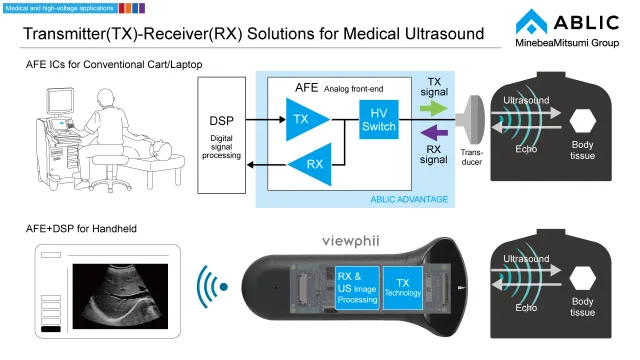
Transmitter(TX)-Receiver(RX) Solutions for Medical Ultrasound (Source: ABLIC)
Why are data centers pushing battery-less leak sensors into industrial demand?
Hanazawa described the battery-less water leak sensor as one of the highest-growth areas, powered by CLEAN-Boost TM, an energy storage and boost circuit that harvests the tiny charge produced when water touches the sensing strip. ABLIC's product materials say the BLE beacon version can transmit a signal in under five minutes under tap-water conditions and detect small drops, while LoRa models are being developed. Those details matter in facilities because the sensor is not simply an alarm; it is an asset-protection control point.
The market context is shifting. Traditional leak sensors were common in factories and buildings, but water-cooled AI servers are pulling demand toward data centers. MarketsandMarkets estimated the global data center leak detection systems market at USD 400.0 million in 2025 and projected it to reach USD 1,300.0 million by 2032, a growth curve that reframes leakage control as part of AI infrastructure resilience rather than routine maintenance. ABLIC says its approach differs from resistance-based electrode designs because water and metal chemistry can reveal leaks even in pure water with low conductivity. That is relevant to Europe, where retrofit projects and smart-city work often lack convenient power wiring, and to Japan, where the sensor already has a broad installed base and pilot testing in infrastructure sites.
In the US and EU markets, ABLIC obtained FCC certification and began sales last year. The company then brought the sensor overseas to a new trade audience in June 2026 at BOMA 2026 in Los Angeles, California, an event that drew strong interest from building and facilities buyers. A separate case also appeared in infrastructure: ABLIC presented verification results on an actual bridge at the JSCE Conference, extending the proof point beyond data centers to bridges, where rainy weather, freeze cycles, and cable trays create real failure modes.
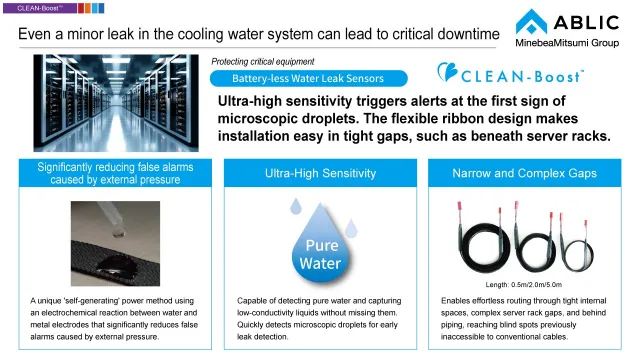
Characteristics and implementation overview of battery-less water leak sensors for data centers (Source: ABLIC)
What should plant, facility, and product teams do with these signals?
Hanazawa said ABLIC aims to raise the share of new products in sales and will continue investing in technology and talent. AI is also entering development, not only the final market. The company is exploring AI-assisted design, with the eventual ambition of covering more stages of the workflow, but Hanazawa stressed that humans must make final decisions, and ABLIC is consulting EDA vendors because of security concerns. For industrial teams, this is a useful warning: AI can shorten design cycles, but analog components used in safety-critical systems still require human verification.
Another actionable signal is the expansion around battery protection. ABLIC intends to propose lithium-ion battery protection solutions for industrial equipment, including energy storage systems and battery backup units that guard against momentary power interruptions in AI servers. It also plans to broaden power management ICs to 48 V architectures, allowing in-vehicle power designs to serve a wider range of electric vehicles and adjacent applications. The 48 V mention is not just an electrical detail; it indicates that automotive, storage, and AI backup power are converging on similar high-efficiency protection problems.
Beyond the five key sectors, Hanazawa said ABLIC wants to create new fields that can become the sixth and seventh pillars of its business. Its public materials use the compact label Small Smart Simple, then explain the same position as Small, Smart, Simple: analog solutions that are small enough to install where space is constrained, smart enough to reduce false alarms and power overhead, and simple enough to maintain in real-world facilities. That phrasing is also a purchasing checklist for managers. It should ask suppliers how much wiring, battery replacement, false-alarm tuning, and system integration work are hidden behind a low unit price.
Decision checklist for industrial buyers
| Risk area | Common pitfall | What to ask before specifying |
|---|---|---|
| AI data-center cooling | Treating leak detection as a one-time compliance item instead of an uptime control. | Can the sensor be retrofitted without new power wiring? What is the alarm latency in real water, not lab water? |
| Medical imaging subsystems | Buying transmit and receive components separately, then adding integration risk. | Does the supplier offer paired transmitter and receiver paths, as ABLIC does with viewphii? |
| Battery and backup power | Assuming 48 V means only EV hardware. | Does the protection architecture also cover ESS and BBU use cases for AI servers? |
| AI-assisted design | Assuming automated design removes the need for human sign-off. | Which verification, security, and documentation steps remain controlled by engineers? |

FAQ: What readers ask about ABLIC's analog growth story
Why does a flat analog market still reward focused suppliers?
Because customers are buying reliability, not only part price. ABLIC's over 10% FY 2025 growth, cited by Hanazawa, shows that value-added niches can offset slow broad demand when the product reduces downtime, false alarms, or integration work.
What makes the medical ultrasound roadmap credible?
The December 2024 Socionext medical acquisition gave ABLIC receiver LSIs to pair with transmitter ICs. The next step is viewphii-Gen 3 sampling and the third-generation model, with ±100V transmit voltage and mass production planned for 2027.
Why are leak sensors an AI infrastructure issue?
Liquid cooling adds water near expensive compute. A sensor that needs no battery or power wiring can be retrofitted into existing facilities in Europe and Japan, while FCC-certified sales in the US and EU let ABLIC address global data-center buyers.
What limits the story?
Trade-show interest and a bridge test at the JSCE Conference do not replace long-term field reliability. Buyers still need to test false-alarm rates, integration with building management or maintenance systems, chemical resistance of sensor strips, and vendor support across regions.
Sources used in this analysis
- ABLIC Battery-less Water Leak Sensor product page: https://www.ablic.com/en/semicon/products/cb/wls/
- ABLIC viewphii sampling update: https://www.ablic.com/en/semicon/news/2026/10/22/viewphii_gen3/
- RSNA annual-meeting dates: https://www.rsna.org/annual-meeting
- MarketsandMarkets data-center leak detection market estimate: https://www.marketsandmarkets.com/Market-Reports/data-center-leak-detection-systems-market-21001589.html
- ABLIC bridge verification and JSCE Conference news: https://www.ablic.com/en/semicon/news/2026/09/08/bl_waterleaksensor_jsce/
Editorial questions can be sent to WorldIndustrialWeekly at news@industrialweekly.com.