
ABB Charts a Robot-First Route for Electrical Inspections: A Deployment Playbook for Plant and Utility Teams
By Michael Torres · Industrial Weekly · WorldIndustrialWeekly industrial operations desk
Key takeaways for operations and maintenance leaders
- Electrical troubleshooting has always put the human at the front of the information gap. ABB's automated-inspection roadmap attacks that ordering: learn what the environment is doing before a crew stands inside it.
- Robot mobility plus thermal, acoustic and optical sensing is what makes the re-ordering possible, because those three channels can be captured from awkward, energized or restricted locations and turned into a defensible condition picture.
- The hardware is not the scarce part. ABB is candid that general-purpose platforms already exist; the hard work is an application layer that lets them operate in copper-rich, safety-critical electrical rooms and feed findings straight into asset-management systems.
- Compliance load is rising underneath the business case: the 2023 edition of NFPA 70B sets infrared scanning of in-scope electrical equipment at intervals no longer than 12 months, and much of that scanning today is done by contracted thermographers during narrow access windows.
- Treat adoption as workflow redesign with stage gates. Programs stall on data plumbing, trust and false-positive management — not on wheels and cameras.
1. Why the "enter first, understand second" habit is under review
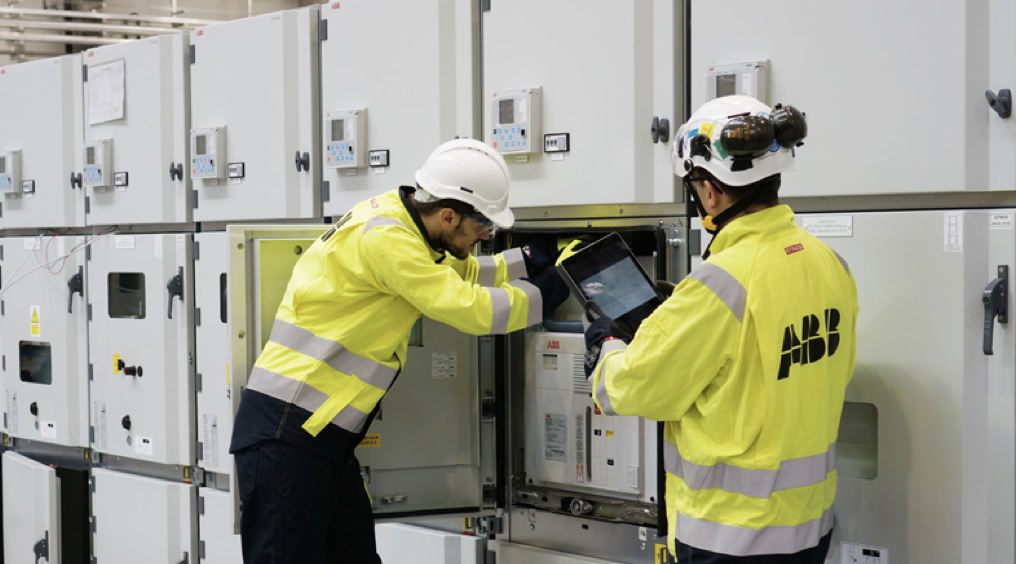
Every electrical trouble ticket contains the same structural flaw. A plant reports an anomaly at a live switchgear room, a substation bay or a motor control center row. A qualified engineer mobilizes, suits up to the correct protection category, and performs the first genuine assessment while already standing inside the hazard envelope. That expertise is indispensable — but it is being exercised with an incomplete picture, which means the highest-consequence decisions get made at the moment when the least is known.
ABB's argument is that today's tooling finally makes it reasonable to close that gap instead of absorbing it. Robotics, sensor performance and software have advanced far enough that a service organization can collect usable condition data ahead of committing people, and the company frames the prize plainly: read the environment before anyone has to enter it.
The exposure statistics explain why industrial leadership is taking the question seriously. NFPA's analysis of the U.S. Bureau of Labor Statistics Census of Fatal Occupational Injuries records 142 workers killed by exposure to electricity in 2023. Safety-industry compilations built around OSHA reporting estimate five to ten arc-flash events a day in the United States, with more than 2,000 hospitalizations annually for severe arc-flash burns. Layer on the regulatory overlay — cable vaults, tunnels and some low-elevation equipment spaces qualify as permit-required confined spaces under rules such as 29 CFR 1910.146 and, on construction scopes, 29 CFR 1926.1204 — and a single "let's just go look" decision stacks two independent hazard control regimes on top of each other.
None of this suggests that energized diagnostics will be handed to a machine. It does, however, put a long-held assumption on trial: that field service engineers must always be the first presence in a potentially hazardous electrical space.
2. What ABB is actually proposing: a three-layer stack, not a robot purchase
Read as an implementation document rather than a press statement, the vision breaks into three layers, and only the middle one is commodity today.
- Platform layer. Mobile or articulated robotic carriers capable of traveling, positioning and surviving in industrial spaces. Suitable platforms are commercially available and improving quickly — this is the part a procurement team can buy this quarter.
- Sensing layer. Thermal imaging, acoustic and ultrasonic monitoring, and high-resolution visual capture, including from locations a person cannot comfortably reach.
- Application layer. The engineering work that makes the first two layers useful in a high-voltage switchroom or a live substation: navigation and safe standoff in cluttered metal-clad layouts, sensor calibration against electrical fault signatures, workflow software that converts captures into findings, and integration with broader asset-management systems. This is where ABB's research and development effort is concentrated, combining service expertise, software development and engineering knowledge.
ABB is equally candid that a large share of this work remains at prototype stage, and that the objective is not robots adopted for their own sake. The test being applied is whether emerging technologies solve real service problems and produce measurable gains in safety, efficiency and operational resilience — a useful discipline for any plant evaluating vendor claims.
3. Matching sensing channels to decisions
The playbook starts with the question most decks skip: what does each channel buy you, and what decision does it change before anyone opens a door?
| Sensing channel | What it can read remotely | Fault signatures surfaced | Decision it informs before entry |
|---|---|---|---|
| Thermal / infrared | Hot-spot location, delta-T across terminations, load imbalance, cooling obstruction | Loose or corroded connections, overloaded circuits, failing contacts, blocked ventilation | Whether entry is needed at all, required PPE category, outage scope, which panels to stage spares for |
| Acoustic, ultrasonic and partial-discharge | Airborne ultrasound, structure-borne noise, discharge activity | Insulation degradation, tracking, corona, loose bus joints, creeping surface discharge | Urgency ranking, whether to move an asset up the maintenance queue, depth of follow-up testing |
| Visual / optical with zoom | Physical condition, indicator and position readings, nameplate and status verification | Debris, water ingress, animal intrusion, breached enclosures, blown fuses, mis-set taps, corrosion | Work package content, tooling and parts list, re-inspection interval, photographic record for trend comparison |
The important detail is triangulation. A hot joint on a thermal frame tells you something is wrong; the same joint showing discharge activity and visible discoloration tells you what is wrong and how fast to act. Teams that capture all three channels also inherit a second asset: a timestamped visual record that lets conditions be compared across cycles rather than reconstructed from memory.
4. A staged deployment playbook
For plants and utility service organizations that want to move deliberately, a six-step sequence keeps the program anchored to operational outcomes rather than technology curiosity.
- Baseline the current inspection workflow. Before any vendor conversation, quantify today's process: asset register and criticality ranking, entry minutes per inspection, PPE and permit overhead, defect backlog, missed-defect history, cost of an unplanned outage on the affected feeder. Without this baseline there is no way to prove improvement later.
- Draw a narrow pilot boundary. Choose two or three assets that combine high hazard, restricted access and repeatable duty — a live medium-voltage switchgear line-up, a substation bay, generator or motor air gaps, a cable tunnel, or the utility plant (cooling systems, pumps, motors) that feeds the electrical distribution. Facility and infrastructure monitoring work around exactly these systems, which is why they make natural pilots.
- Fix acceptance metrics before procurement. Practical measures that hold up in a management review: time from data capture to a usable finding, human entry-minutes avoided, detection rate versus the incumbent thermographer baseline, false-positive tolerance agreed with the crew, and coverage of target assets per cycle.
- Invest in the application layer, not just the platform. Budget for navigation in metal-clad, RF-hostile rooms, sensor-to-fault-signature calibration, EMI robustness, and an integration path into the enterprise asset-management system so a finding becomes a work order instead of an orphan image file. This is precisely the gap ABB describes between a commercially available robot and a platform that operates effectively in complex, safety-critical electrical environments.
- Design the human-in-the-loop decision path. Engineers define what should be inspected, interpret findings and recommend corrective action. What automation changes is the input to those judgments: the crew arrives with thermal, acoustic and visual context instead of discovering it at the panel.
- Scale with data governance and competency changes. Before multiplying pilots, settle model versioning, data ownership and retention, cybersecurity review of any device inside a critical-infrastructure boundary, and the training path for staff who now read instrument data remotely. Update standard work and inspection intervals so the improved visibility actually changes maintenance decisions — otherwise the pilot becomes an expensive camera.
5. Reference cases and adjacent signals
The data-first precedent at Avedøre. In a June 17, 2026 announcement, ABB and Ørsted disclosed a pilot of AI-based electrical fault prediction at Avedøre Power Station in Denmark, using electrical data already available in relay and control systems to raise reliability at a site the utility describes as critical. Søren Bagge Skou of ABB characterized the core problem in operational terms: broadly, most electrical faults build up over time, but they are often only discovered late, leaving little room to respond. ABB will support Ørsted through the first year of the pilot, working closely with site teams so that insights are relevant and actionable. For an industrial reader, the instructive part is the sequencing — earlier detection, faster diagnosis and better-informed maintenance decisions, delivered through existing infrastructure before any new machine is deployed.
The vision-platform move. Also relevant to factory-floor teams: ABB Robotics released an AI-powered visual inspection platform designed to extend beyond specific robot models or fixed stations, a step reported by Automation World coverage in July 2026 as manufacturers pushed physical AI and data governance to the front of the automation agenda. Alongside a white paper with NVIDIA on industrial-grade physical AI, it signals that the same perception-and-governance problem being solved on production cells is the one electrical service work must solve in switchrooms.
Seeing inside without opening. This is not an entirely new idea for the company: ABB's Air Gap Inspector, described as one of the world's smallest robots, has been used to perform visual inspection inside motors and generators — capturing information that previously required teardown. It is the clearest existing proof that inspecting a hazardous or inaccessible interior without disassembly is technically mature in narrow applications.
Utility-side pilots. Across the power sector, mobile inspection robots have been trialed for visual and thermal substation rounds — including an Avangrid pilot announced in 2024 and a utility deployment of a quadruped robot at two substations reported by Public Power. Guidance emerging from vendors of autonomous infrared inspection robots for yards at 110 kV and above converges on the same operational advice: divide the site into patrol routes by voltage class, asset density and hazard level rather than chasing a single all-seeing machine.
6. Common misconceptions to retire before kickoff
- "This is headcount reduction." ABB's own framing rejects it. Condition-inspection technology should not be read as a cost-cutting measure; the goal is that the same team achieves more, with better tools, better information and better support, working more safely and effectively. Savings, if they appear, come from shorter outages, fewer re-mobilizations and better first-time fix rates.
- "A robot can substitute for a qualified person." Mobile platforms do not inherit your electrical safety program. Energized work, arc-flash boundaries and lockout obligations remain attached to human work — the robot only changes what is known before that work is scheduled.
- "Buy the hardware, sort out the data later." This is where budgets leak. Without the application layer and asset-management integration, captures sit in a silo and nobody's maintenance decision changes.
- "One thermal pass is enough." A single-channel annual snapshot satisfies a checklist; it is not a condition-monitoring program. Cross-checking thermal with acoustic and visual data is what converts detection into diagnosis.
- "A successful pilot means we are ready to scale." MIT's NANDA study of enterprise AI, widely reported by Fortune in August 2025, put the share of generative-AI pilots delivering no measurable ROI at around 95% — a failure pattern attributed mainly to workflow integration, not model quality. Inspection AI is not exempt from that statistic.
- "More alerts equal better safety." Untriaged alerts are noise, and crews stop trusting a system faster than they adopt one. Agree a false-positive threshold and a named reviewer before going live.
7. Year-one risk register: what actually goes wrong
- Communications and navigation. Metal-clad rooms are RF-hostile; steel grating, cable tray, oil pits and tight aisle widths defeat platforms designed for clean warehouse floors. Survey the pilot route physically before promising autonomy.
- Environmental and equipment suitability. Battery-carrying devices introduced into fault-energy environments, temperature extremes and wash-down or outdoor yards need a documented hazard assessment — the machine becomes a new risk, not only a mitigator.
- Cybersecurity and data ownership. Any device inside a substation or plant distribution boundary is a network node. Specify data retention, model provenance, remote-access rules and exit rights to the inspection dataset in the contract.
- Competency drift. If junior staff never enter a switchgear room for the first pass, the interpretive skill that made senior engineers valuable can atrophy. Build remote-reading competence into training, not in place of it.
- Permit obligations unchanged. Follow-up corrective work in vaults and tunnels remains subject to permit-required confined space regimes; robotics shortens exposure, it does not delete paperwork.
- Procurement mismatch. Pilots funded as tooling capex and measured on utilization tend to fail; they behave more like process-change projects and should be governed as such.
8. Framing the economics honestly
Benchmark studies of mature predictive-maintenance programs, including figures commonly attributed to McKinsey, point to machine downtime reductions of roughly 30% to 50% and asset-life extensions of 20% to 40%. Those numbers are worth quoting as a ceiling, not importing as a plan: they come from well-run, integrated programs, not from a camera on a chassis. The defensible first-year case for automated inspection is usually expressed in three lines — entry-minutes avoided per inspection cycle, outage windows shortened because parts and personnel are staged correctly the first time, and defects caught before they escalate into forced downtime.
A second economic argument sits on top of the compliance clock. With NFPA 70B's 2023 edition mandating infrared inspection of equipment in scope at intervals not exceeding 12 months, the scanning workload itself has become a scheduling constraint for plants with large distribution inventories. Continuous or semi-continuous robotic capture does not replace a mandated thermographic survey, but it changes what the annual event has to discover — and it can move routine reading of the same equipment off the critical path.
9. FAQ for the first conversation with your reliability team
Does automated inspection mean fewer electrical service engineers?
No. ABB's position is that human judgment is irreplaceable because these environments are complex and every decision carries consequences. Engineers will still determine what is inspected, interpret what is found and recommend action. What changes is that repetitive, hazardous or hard-to-reach collection work no longer consumes their attention or their exposure budget.
Is this available today, or is it a roadmap?
Both. Suitable robotic platforms are commercially available and improving rapidly, while the electrical-service-specific application layer that makes them operate reliably in safety-critical switchrooms is largely still in development and prototype form — which is why a phased, metric-driven pilot beats a big-bang rollout.
What if we cannot fund a robot program this year?
Start one layer down: fixed thermal and acoustic sensors on the two or three most consequential assets, plus disciplined documentation of visual findings so conditions can be compared over time. Facility monitoring teams in semiconductor and process plants use exactly this approach to prioritize attention across electrical, mechanical and cooling systems.
Who should own the inspection data?
Reliability or asset management, not the vendor and not IT alone. Ownership includes retention rules, model versioning and the right to reuse historical captures — the dataset is often worth more than the platform that collected it.
Which assets make the best first target?
High hazard, poor access, high criticality and repeatable duty. Live switchgear rows with limited entry windows, generator and motor interiors, cable tunnels, and utility systems feeding distribution are the standard candidates.
How do we prove the pilot worked?
Against the baseline captured in step 1: entry-minutes avoided, time-to-insight, detection rate versus the previous method, first-time fix rate on follow-up work orders, and any change in unplanned outage frequency on the affected feeders. Report all five, including the ones that did not improve.
10. Action checklist: first 180 days
- Days 1–30. Baseline inspection workflow and entry minutes; rank assets by hazard × criticality × access difficulty; pull the current NFPA 70B survey scope and interval plan; identify which spaces are permit-required confined spaces.
- Days 31–90. Select two or three pilot assets; write acceptance metrics and a false-positive threshold with the crew, not for them; survey communications and physical routes; define the human-in-the-loop review step and name the reviewer; agree data-ownership and cybersecurity terms with any vendor before a demonstration is scheduled.
- Days 91–180. Run the pilot side by side with the incumbent method for at least two full cycles; connect findings into the asset-management work flow; update standard work and inspection intervals where the new data justifies it; hold a go/no-go review on scaling, using the MIT integration-failure pattern as a deliberate checkpoint.
Bottom line
The direction of travel is not seriously in doubt, and neither is the guardrail: the intention is to keep people in field service, not to remove them. What is changing is the order of operations — condition data gathered first, human judgment applied second, exposure paid for only when it buys something that cannot be seen from outside. For plant and utility managers, the practical response is modest and immediate: baseline your inspections, narrow the pilot, write the metrics down, and put the money into the application layer where the real work is. Do that, and when your engineers do walk into a live switchroom, they arrive with more knowledge and less risk than any generation before them carried.
Sources consulted beyond the original ABB briefing: NFPA research on fatal occupational injuries from electricity exposure and the NFPA 70B (2023) electrical equipment maintenance standard; OSHA permit-required confined space regulations (29 CFR 1910.146 and 29 CFR 1926.1204); ABB's June 17, 2026 announcement on the Ørsted Avedøre fault-prediction pilot; Automation World and Marketscale reporting on ABB Robotics' AI-powered visual inspection platform; Fortune's August 2025 coverage of the MIT NANDA enterprise-AI study; Avangrid and Public Power reporting on quadruped substation inspection pilots; Microsoft Transform on the ABB Air Gap Inspector; McKinsey-derived predictive-maintenance benchmarks as summarized by ReliaMag.