Beyond 12V: What the 48V Zonal Transition Means for Vehicle Weight, Connector Standards and the Factory Floor
By Michael Torres, Industrial Weekly
Every camera, steering sensor and driver-assistance function added to a vehicle today also brings copper, connector part numbers and new assembly steps with it. That is the practical reason the automotive supply chain is starting to walk away from the 12V system it has relied on for decades: as vehicle systems — and electric vehicles in particular — grow more complex, legacy wiring strategies are nearing their limits, and functions that need more power must still fit inside a tightly constrained weight budget. For platform, plant and supplier-program managers, the move to 48V should therefore be read not as a component substitution but as a re-organization of how power, data and production are planned together.
Seen from that angle, the value proposition is concrete rather than theoretical. A 48V battery system delivers many of the benefits normally associated with high-voltage electrification while holding safety risk, cost and complexity at a lower level, and it supplies the base on which zonal layouts, lighter harnesses and automated assembly can be designed as a single package instead of negotiated one feature at a time.
Why the 12V domain model runs out of room
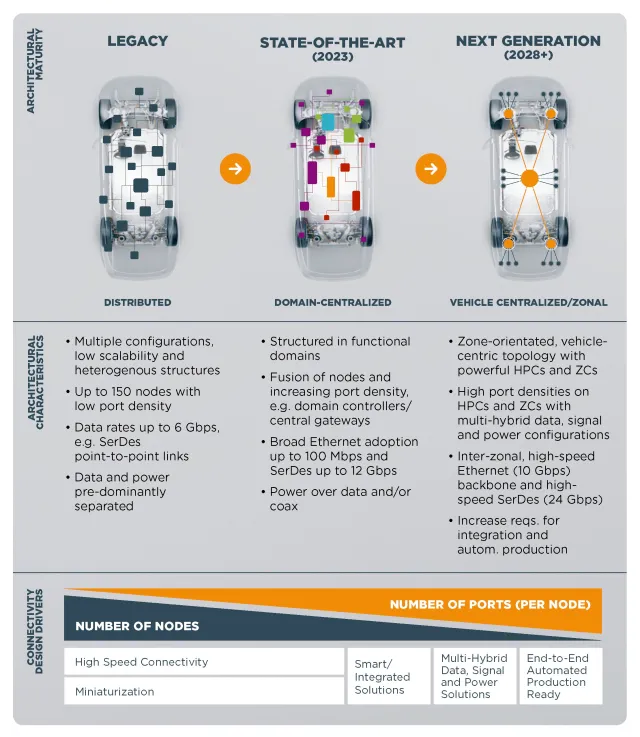
A modern car behaves increasingly like a network of electronics — in many ways a powerful, driveable smartphone. Under the older domain-based electrical architectures, electronic control units (ECUs) were distributed across the vehicle in a web-like pattern. The consequence of that layout is highly predictable. Add a feature — a camera, a headlamp, a steering sensor — and additional wires must cross the vehicle, so complexity and mass climb together. Manufacturing becomes more difficult, and efficiency weakens as a result.
The real constraint for organizations balancing content growth against weight and cost targets is therefore not available wattage alone. It is the accumulation of cross-vehicle runs that every new function drags behind it.
Zonal architecture: grouping hardware by position
Zonal architecture takes the opposite route. Components are organized into zones — front, rear, left door and right door are typical examples — with each zone supervised by a local zonal computer, while a central vehicle computer links those zones so communication remains seamless.
The operational payoff comes from the connections that no longer have to be made. With fewer runs crossing the car, wiring is lighter, assembly is easier, and new functions can be introduced without making the architecture itself more complicated. That is precisely the point at which voltage enters the picture, because topology simplification on its own is not enough.
The physics that makes 48V the enabling step
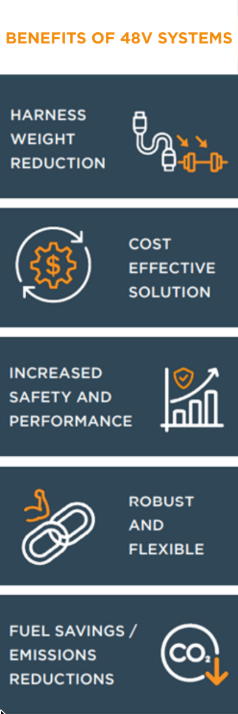
For a given amount of power, a higher voltage needs a lower current. Operating at 48V rather than 12V allows thinner wires and smaller connectors to be used and, depending on vehicle design and use case, that reduces weight by up to 75 percent.
Reduced current also means reduced electrical losses, so the mass saving arrives alongside better overall vehicle efficiency and range. The benefit extends past the harness as well. Because a 48V system cuts electrical losses and permits higher power delivery at lower current, it supports advanced functions that are difficult to implement on a stretched 12V architecture: electrically driven compressors, active chassis and steering systems, and energy recovery functions all benefit. In electrified and hybrid platforms, the same headroom can reduce power and fuel consumption, lower emissions and improve system responsiveness.
When voltage rises, the connector becomes the safety question
Higher voltage reshuffles design priorities. If it is not properly managed, arcing can still occur — especially at the moment of connection or disconnection under load. To prevent sparks or short circuits, connectors must maintain adequate creepage and clearance, a requirement that matters most in environments where moisture, dust or debris may be present.
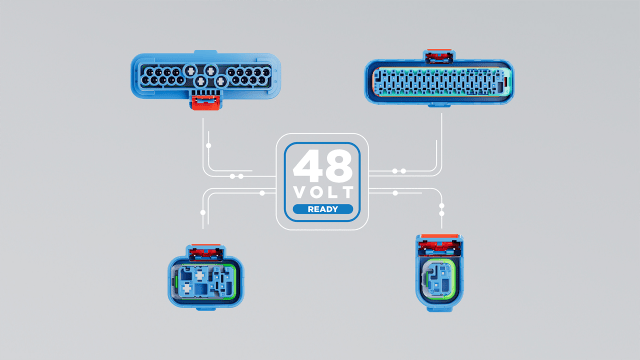
The new Low Voltage Connection Standard (LVCS) was developed specifically for 48V operation to answer these challenges. TE Connectivity leads the area as the engineering partner behind a production-ready solution, setting a reliability benchmark for harsh environments. LVCS products designed for 48V address the requirements needed to meet global standards while holding consistent voltage ratings and reducing risk during assembly; in contrast to legacy 12V connectors, they are built from the outset with 48V safety margins and environmental conditions in mind.
Designing the interface for the robot as well as the operator
Safety is one half of the story; manufacturability is the other. Traditional 12V connectors are hardly simple parts, yet they were never designed for automated assembly either. The LVCS solution adds positive gripping features along with horizontal and vertical retention and guiding elements so robots or operators can plug connectors into place reliably. Some connectors even provide electronic confirmation, sending a signal to the car software if a connection is not fully sealed.
These details look small and behave large. Seating a connector becomes a verifiable process step rather than a manual judgement — exactly the kind of change that transforms vehicle assembly while keeping workers safe.
Interface count as a supply-chain metric
A second lever sits above individual connector design: interface consistency. Modern vehicles contain more than 150 different connector types, a complexity challenge for OEMs and suppliers alike. LVCS was introduced to compress that variety dramatically, consolidating interfaces down to 13 options fully standardized for 48V compatibility.
The downstream effects will be familiar to anyone who has managed part proliferation: simpler wiring, fewer part numbers, less confusion on the assembly line, fewer potential points of failure — and an electrical system that is easier to scale across multiple vehicle models. For OEMs adopting zonal architectures, this standardization is a powerful solution because it aligns the electrical system with vehicle design; limiting interface proliferation early in development lets manufacturers scale across platforms without redesigning the wiring every time a feature is added.
Legacy 12V domain layout versus a 48V zonal layout
| Design dimension | Legacy 12V domain layout | 48V zonal layout |
|---|---|---|
| Control unit placement | ECUs spread by function across the vehicle | Local zonal computers for front, rear, left door and right door, linked by a central vehicle computer |
| Cross-vehicle wiring | Every added feature pulls additional runs through the car | Fewer connections running across the car |
| Conductor and connector size | Sized for higher current at 12V | Thinner wires and smaller connectors for the same power at lower current |
| Mass | Rises with each new function | Reductions of up to 75 percent depending on vehicle design and use case |
| Connector variety | More than 150 different connector types in modern vehicles | Consolidated to 13 standardized LVCS interfaces rated for 48V compatibility |
| Assembly | Connectors were not designed for automated assembly | Gripping, retention and guiding features support robotic and manual seating, with electronic confirmation on some parts |
| Supported functions | Stretched by high-load electronics | Electrically driven compressors, active chassis and steering, energy recovery, steer-by-wire and brake-by-wire |
| Platform scaling | Wiring tends to be redesigned as features arrive | Standardized interfaces make scaling across models easier |
A typical program path: reading the transition step by step
The industry contains both EV-native players and traditional OEMs, and the two move at different speeds, so the switch will often arrive as a sequence of incremental upgrades rather than a single clean-sheet event. A representative project flow looks like this:
- A content request lands — an electric compressor, an active steering function, an added sensor cluster — and is first evaluated against the existing 12V harness, where it would add further cross-vehicle runs.
- The request is re-scoped into a zone: a local zonal computer takes control, the run length shrinks, and power is delivered at 48V so current and conductor size come down.
- The interface is chosen from the standardized LVCS menu instead of opening a new bespoke connector part number, holding the long-term part count toward 13 rather than adding to the 150-plus today.
- Assembly is planned around gripping, retention and guiding features, with electronic seating confirmation where the connector provides it, so robotic or operator plugging is verifiable.
- Software is assigned the load-balancing task: as steer-by-wire, brake-by-wire and electric compressors join the 48V network, loads shift between 48V systems and the main traction battery when necessary, keeping performance consistent and avoiding unnecessary strain on any single power source.
Two habits determine whether such a program stays manageable. The first is early collaboration: when component suppliers engage during advanced development phases, electrical architectures and connector systems can be shaped around anticipated needs while remaining adaptable to future loads, even ones not yet defined, creating a feedback loop that keeps designs relevant across the next several vehicle generations. The second is refusing to over engineer for worst-case scenarios; 48V systems are developed to support flexibility, allowing requirements to evolve as architectures mature and new technologies emerge.
Figures cited in this analysis
- Voltage step: from 12V to 48V for the vehicle's low-voltage power network.
- Mass: thinner wires and smaller connectors can cut weight by up to 75 percent, depending on vehicle design and use case.
- Connector variety today: modern vehicles contain more than 150 different connector types.
- Targeted standardization: LVCS consolidates interfaces to 13 options fully standardized for 48V compatibility.
- Programme effect: lighter wiring and fewer part numbers reduce material use, simplify assembly and lower production costs, while standardized interfaces support higher automation levels such as automated wiring harness assembly.
Common misconceptions
- "At 48V, arcing is no longer a concern." If not properly managed, arcing can still occur, particularly during connection and disconnection under load; creepage and clearance must be maintained even where moisture, dust or debris are present.
- "The weight saving comes from voltage alone." Architecture simplification by itself is not enough either — the mass benefit comes from combining a zonal layout with lower current.
- "Existing 12V connectors can be carried over with a note on the drawing." Legacy parts were not built with 48V safety margins and environmental conditions from the outset, nor were they designed for automated assembly.
- "Fewer interfaces means less design freedom." Limiting interface proliferation early is what allows electrical systems to scale across platforms without a wiring redesign for each new feature.
- "The transition is all-or-nothing." With EV natives and traditional OEMs moving at different speeds, the switch to 48V may come through incremental upgrades while its impact remains far-reaching.
- "Standardization is a supplier initiative, not a plant one." Automation-ready gripping, retention and guiding features change how the vehicle is built, not just how it is specified.
Action guidance for engineering, sourcing and operations
- Price every new function by its wiring cost as well as its electronic cost, since cross-vehicle runs are what drive complexity and mass.
- Set an interface ceiling at program start and hold it, steering designs toward the standardized 13-option LVCS menu instead of adding connector part numbers.
- Bring connector and component suppliers into advanced development phases so architectures anticipate future loads rather than react to them.
- Write automated assembly into the specification: positive gripping, horizontal and vertical retention, guiding elements and, where offered, electronic confirmation of a full seal.
- Treat load balancing between the 48V network and the main traction battery as a software deliverable with clear ownership.
- Sequence legacy platforms through incremental upgrades, and validate zonal grouping where feature growth is fastest.
- Track the factory-side metrics explicitly — material use, part numbers, assembly errors and automation readiness — because they feed commercial viability and, eventually, consumer benefits.
Questions decision-makers ask first
Does 48V replace the high-voltage traction battery?
No. The 48V network works alongside the main traction battery, taking on functions such as steer-by-wire, brake-by-wire and electric compressors while software shifts loads between the two when necessary.
How much weight is really at stake?
Because a higher voltage needs a lower current for the same power, thinner wires and smaller connectors can be used and, depending on vehicle design and use case, weight falls by up to 75 percent.
Why does connector count matter so much?
A modern vehicle carries more than 150 different connector types. Consolidating to 13 standardized 48V options produces simpler wiring, fewer part numbers, less assembly-line confusion and an electrical system that scales more easily across models.
Can our lines robotize harness assembly with these parts?
That is the design intent. Gripping, retention and guiding elements let robots or operators seat connectors reliably, and some connectors send a signal to the vehicle software when a connection is not fully sealed.
Do hybrid and non-EV platforms gain anything?
Yes. In electrified and hybrid platforms, lower electrical losses and higher power delivery at lower current can reduce power and fuel consumption, lower emissions and improve system responsiveness.
Should we over engineer for every future feature?
The case for 48V rests on the opposite approach: systems developed to support flexibility, so requirements can evolve as architectures mature and new technologies emerge.
For the people who actually build vehicles, the conclusion is operational rather than speculative. Voltage, topology and connector choice are no longer three separate conversations held in three separate departments; they are one decision that determines how heavy a harness is, how many part numbers purchasing must manage, how reliably a robot seats a connection, and how easily the next feature can be added without a redesign.
The wider shift toward zonal electrical design, lower wiring mass and higher supported loads bridges legacy platforms to fully software-defined, electrified architectures — and standardized low-voltage connectivity brings simplicity to an increasingly complex electrical landscape. Fewer interfaces, safer connector designs and automation-ready features let manufacturers balance rising performance and safety requirements with manufacturing efficiency, and they lay the foundation for vehicles that are more efficient, more capable and more sustainable.