
WorldIndustrialWeekly General Brief: Four 3D Printing Research Threads from X-Hinges to Color Routers
For plant managers, capital-project teams and R&D leads, the most useful way to read the current additive manufacturing news flow is operational: which constraints are being removed, and what proof has already been shown? With Formnext only a few weeks away, this WorldIndustrialWeekly General update groups four research threads from MIT & TJU, Oak Ridge, Sichuan University, and SUTD around decisions they affect on the shop floor, in nuclear infrastructure, in soft robotics, and in imaging systems. engineering.com has followed the space, and the pattern here is clear: software, materials, geometry, and sensing are becoming part of the value equation.
Case snapshot 1: X-Hinges puts sensors where motion is read
The MIT & TJU project, "X-Hinges," is presented as a software workflow rather than a new printer. Engineers at MIT and Tianjin University (TJU) in China use the tool to place sensors into 3D models at articulation points. In a robotic-hand example, sensors are positioned at joints to capture motion data, giving the printed device a better basis for responding to user intent.
“It’s kind of like adding a conscious element to everyday objects,” said Jiaji Li, MIT electrical engineering and computer science (EECS) postdoc. “What you get is objects that better understand how they’re being used and have more ways to respond. In the same way an AI agent is programmed to make certain decisions based on our instructions, these creations have built-in sensing to adaptively react to human touch.”
The proof of concept is a glove that records finger-joint bending and relays that information to a humanoid robot hand. The team notes that most methods permit one axis of motion because signal interference limits channel separation; the new approach supports movement from three angles while recording each area simultaneously.
“Most methods only allow for one axis of motion, often due to signal interference. X-Hinges enables your 3D printed item to move from three angles,” said lead author Xiang Chang. “Ultimately, you get a design with the intended movement you want. It also records motion data in each of those areas at the same time, making the device responsive to different kinds of interactions.”
The paper is available on arXiv and is scheduled for presentation at the ACM Symposium on User Interface Software and Technology (UIST) next month.
Case snapshot 2: Oak Ridge composite formwork compresses nuclear schedule
For energy and construction managers, Oak Ridge National Laboratory (ORNL) is the clearest schedule signal in the update. Oak Ridge is addressing the slow delivery of concrete molds through "Advanced Composite Formwork for Accelerated High-Precision Nuclear Infrastructure," a collaborative effort that uses 3D printed fiber-reinforced composite forms.
The project includes ORNL’s Manufacturing Demonstration Facility and partners: Kairos Power, University of Maine’s Advanced Structures and Composites Center (Maine), Barnard Construction, Airtech Advanced Materials Group, JuggerBot 3D, Additive Engineering Solutions, Haddy, and Tru-Design. In a matter of days, Kairos Power and Barnard Construction teams completed the Janus cast-in-place concrete demonstration.
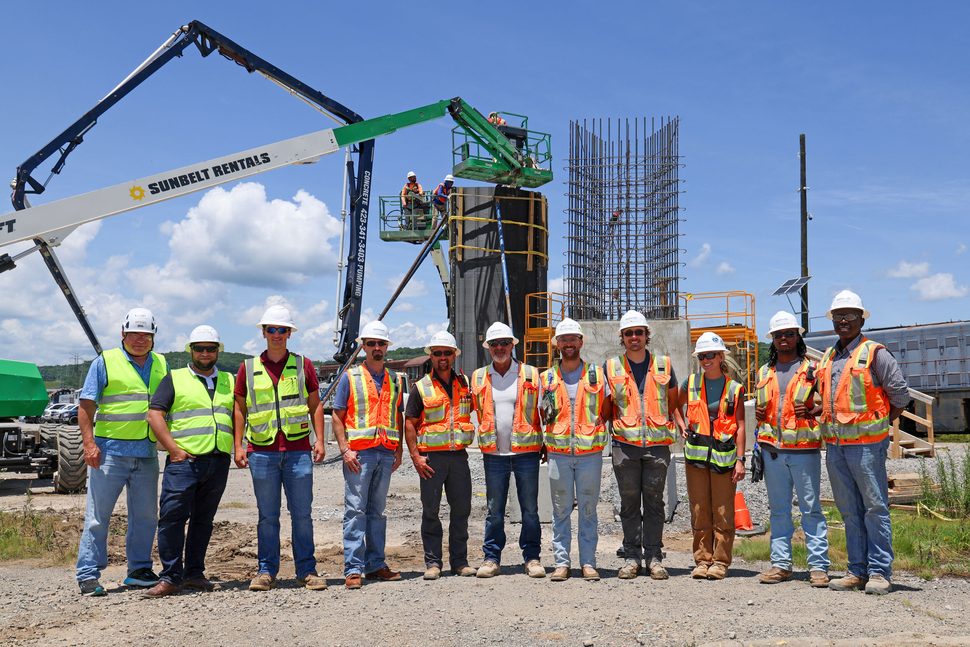 In a matter of days, Kairos Power and Barnard Construction teams completed the Janus cast-in-place concrete demonstration. IMAGE: Kairos Power
The reported delivery window is roughly two weeks, versus six months for conventional steel molds, while critical surfaces reach one-sixteenth-inch precision under concrete pressure.
“Accelerating advanced nuclear deployment requires rethinking how we build, not just how we design reactors,” said Ahmed Arabi Hassen, group leader of composites innovation at ORNL. “Conventional formwork is costly, labor-intensive and too slow to support the pace and scale of future nuclear construction. Through large-scale additive manufacturing and strong industry partnerships, we are transforming this bottleneck into an opportunity to build faster, smarter and more affordably.”
The effort received the 2026 CAMX Combined Strength Award.
Case snapshot 3: Sichuan University links soft bodies and liquid-metal traces
Soft robotics teams face a reliability issue: pliable synthetic bodies must be combined with metallic pathways that can fracture under repeated strain. Sichuan University in China addresses that with stereolithography (SLA) and laser-induced selective metallization, using a magnetic liquid-metal slurry made from Galinstan and iron particles.
The reported trace width is 58.6 μm, with electrical isolation maintained at gaps as narrow as 40.23 μm. The method can make flexible devices that crawl on flat surfaces and slopes, move across water, shield electromagnetic interference, and repair cut conductive traces with magnetic assistance.
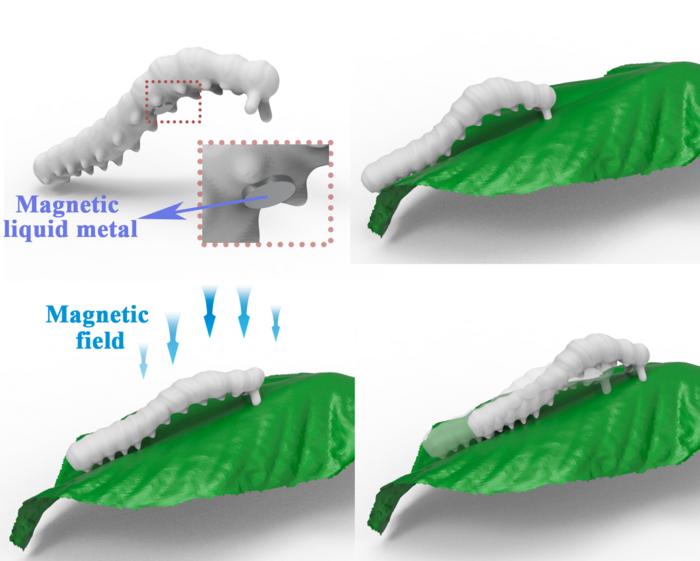 On the abdomen of a soft, 3D-printed caterpillar, a magnetic liquid-metal pattern responds to changes in an external magnetic field, driving alternating extension and contraction that enables the robot to climb a slope. IMAGE: Siying Li, Pengan Luo, Hao Lu, Haoran Xu, Feifan Yu, Jin Feng and Tao Zhou
When the slurry was patterned on a caterpillar abdomen, alternating magnetic fields made the robot buckle and extend; it moved 3.5 cm in 15 seconds and climbed a 30° ramp.
The team cautions that metal-ion leaching into human tissue during contact with acidic sweat or physiological fluids still needs verification, and thin, breathable polymer coatings must protect traces without compromising flexibility. The paper appears open-access in the International Journal of Extreme Manufacturing.
Case snapshot 4: SUTD color routers redirect light instead of filtering it
For optical module developers and imaging-system engineers, low-light performance is a system problem. Researchers at Singapore University of Technology and Design (SUTD) in Singapore designed a color router that steers light toward sensors rather than filtering it, reducing noise, exposure time and motion blur.
“A Bayer filter separates colors by letting one color through and absorbing the others,” explained professor and lead researcher, Joel Yang from SUTD. “A color router instead steers those colors towards the corresponding sensing regions, allowing three times more of the incoming light to be used.”
Earlier routers used high-refractive-index materials such as titanium dioxide or gallium nitride, which require precise multi-step fabrication. The SUTD team used low-refractive-index materials—ordinary polymers and glasses—because 3D printing’s geometry flexibility can compensate for weaker light interaction.
“Building on our experience with 3D-printed polymer optics, we wanted to explore whether carefully optimized geometry could overcome that limitation,” said lead author and SUTD PhD candidate, Pan Cheng-Feng.
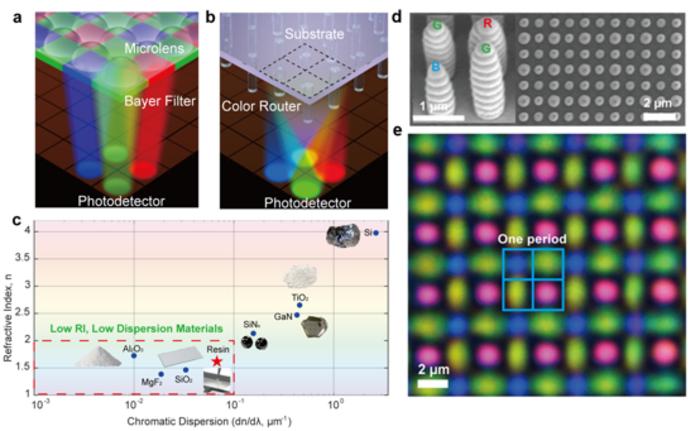 Low-refractive-index color routers for image sensors are shown: (a,b) schematics comparing a conventional Bayer-filter sensor with a color-router-based sensor; (c) refractive index and chromatic dispersion comparison for representative optical materials, highlighting low-index, low-dispersion materials; (d) scanning electron micrographs of fabricated polymer nanopillars and periodic array; (e) optical image of routed color pattern, with one RGGB unit cell outlined. IMAGE: SUTD
In the design, each unit cell contains four cylindrical nanopillars printed by two-photon polymerization (2PP). The pillars scatter light collectively, routing red, green, and blue wavelengths to target sensing regions.
“The four pillars act as a coordinated optical system,” said Pan. “A pillar positioned beneath the red sensing region is not simply an independent ‘red pillar’. In our design, the desired routing emerges from the collective response of the complete arrangement.”
Reported results include improved color fidelity with a third of the exposure time compared with a standard filter-based sensor. Simulations show routing efficiency of almost 90 percent across the visible spectrum versus 20-35 percent for an off-the-shelf filter. Printed arrays of 250,000 unit cells across a one-millimeter square achieved approximately 70 percent efficiency; the team attributes the drop to fabrication deviations. The study appears in Nature Communications.
Data references: what the numbers mean for industrial planning
| Research thread | Reported data | Planning signal |
|---|---|---|
| X-Hinges | three angles vs one axis of motion; UIST next month | Useful when a printed part needs motion-state data at articulation points |
| Oak Ridge formwork | from six months to roughly two weeks; one-sixteenth-inch; in a matter of days; 2026 award | High-precision molds may become a schedule lever in nuclear infrastructure |
| Sichuan University | 58.6 μm, 40.23 μm, 3.5 cm, 15 seconds, 30° | Track both performance metrics and biocompatibility/coating gaps |
| SUTD | three times, a third, almost 90 percent, 20-35 percent, 250,000 unit cells, one-millimeter square, approximately 70 percent | Prototype optics can improve light use, but array scaling remains open |
Common misconceptions to avoid
- Treat X-Hinges as hardware-only innovation. The reported contribution is software that places sensing at relevant articulation points.
- Assume the Oak Ridge result makes all nuclear construction fast. It targets formwork; nuclear plant building remains time-intensive.
- Read SUTD’s almost 90 percent simulation as a production-ready array metric. The one-millimeter square array reached approximately 70 percent because of fabrication deviations.
- Presume Sichuan University’s 58.6 μm traces are already safe for long human contact. Metal-ion leaching verification and protective coatings remain listed concerns.
Action recommendations for readers tracking additive manufacturing
- Map part geometry and sensor placement together. For interactive printed assemblies, ask where motion must be captured, then test whether the X-Hinges model can place sensing at those joints.
- Separate design speed from construction speed. If your project has concrete-form schedule pressure, benchmark composite formwork against conventional steel molds using delivery time, tolerance, and cast performance.
- Log material limits with operating data. For soft devices, record width, gap, movement, slope, and environmental exposure so later safety tests can be compared.
- Track prototype-to-array losses. In imaging or optics pilots, record simulated efficiency, measured array efficiency, exposure time, color fidelity, and leakage improvements.
As Formnext approaches, the practical filter for WorldIndustrialWeekly General readers is simple: does the update provide a validated data point, a named partner chain, or a remaining verification gap? These four threads offer all three.
FAQ
Which research is closest to industrial scheduling?
Oak Ridge National Laboratory (ORNL) and partners, because the reported formwork timeline moves from six months to roughly two weeks and the project received the 2026 CAMX Combined Strength Award.
What is the main proof point for X-Hinges?
A glove that captures finger movement and relays it to a humanoid robot hand, with sensing across three angles rather than one axis of motion, per arXiv and the upcoming ACM Symposium on User Interface Software and Technology (UIST) presentation next month.
What still needs verification for the liquid-metal skin?
Sichuan University says metal-ion leaching into human tissue during prolonged contact with acidic sweat or physiological fluids needs verification, and thin breathable coatings are needed to protect exposed traces.
Why does the color router matter for cameras?
SUTD’s approach steers red, green, and blue wavelengths instead of filtering them. Reported improvements include three times more incoming light used, a third of exposure time in images, and a routing-efficiency comparison of almost 90 percent against 20-35 percent; Nature Communications is the publishing venue.