
Field Data vs. Back Office: Reading the Six 2026 Trimble Construction Innovation Awards as a Buyer's Benchmark
Construction technology pays back where it deletes handoffs, not where it adds machines. Judged against that test, the Six organizations and educators recognized by Trimble sort into four execution patterns and two talent patterns, and every reported gain — 10–30% overall project productivity, 25% data-management efficiency, 88% faster lien processing — traces to continuous information flow or automated administration rather than to hardware alone.
The backdrop gives those figures meaning for industrial readers. A 2025 Federal Reserve Bank of Richmond Economic Brief records that construction labor productivity fell by more than 30 percent between 1970 and 2020 while economy-wide productivity roughly doubled, and Goldman Sachs' review of the same puzzle attributes only about 0.8 percentage points of annual productivity gain to technological change since 1965. Against a line that flat, an awards shortlist that isolates workflow wins is worth reading as a benchmark sheet rather than as vendor publicity.
What exactly was judged, and who scored it?
Conclusion first: an open-entry program scored by peers and press rather than by the vendor alone. The awards were presented in four construction categories, and two educators were recognized for shaping the next generation of industry talent through education and advocacy. Every company in North America that uses Trimble technology for architecture, engineering and construction projects could submit applications for the Construction Innovation Awards, and a panel of Trimble judges, trade media journalists and past award-winning companies selected the winners.
This cycle also added a new outstanding educator category recognizing K-12 and higher education teachers who prepare future industry leaders through innovative technology integration and career advocacy. Winners received a complimentary pass to Trimble Dimensions, November 9-11, 2026 in Las Vegas. That pass is a real line item: Trimble's own Dimensions event pages describe a 2026 conference program of nearly 700 sessions, which for a mid-size contractor is frequently a larger training authorization than the software credit the same deal would otherwise unlock. In its announcement of the 2026 slate, Trimble said the "award winners showcase the transformative power of Trimble technology and their ingenuity in deploying it to advance our industry."
Trimble named three additional companies as runners-up — Plateau Excavation, DBM Vircon and American Excavating. That shortlist leans toward sitework and earth contracting, which signals where the vendor's deepest installed base sits, and where reference calls will be easiest to arrange.
Which adoption pattern delivered which result?
Conclusion first: the four execution patterns differ more in prerequisite than in product list. Two of them (connected ecosystem, process transformation) monetize data continuity across departments; one (project success) monetizes early reality capture; one (workforce achievement) monetizes administrative throughput with no field hardware at all.
| Pattern | Representative winner | Technology spine | Reported result | Fits which operation | Trade-off accepted |
|---|---|---|---|---|---|
| Connected ecosystem | F+F Mechanical, North Haven, Connecticut | Trimble Connect, ProjectSight | 10–30% productivity increase on projects | MEP and fabricating subcontractors with in-house shops | Every department must give up private spreadsheets for one shared model |
| Process transformation | Wade Trim, Detroit, Michigan | Trimble Access, Trimble Connect, cellular-connected GNSS base-station network | 10% under budget on survey scope, 25% better data management, 20% less survey rework | Survey and geospatial teams on linear assets | Value depends on the client's GIS team staying in the same loop |
| Project success | Land to Sand Site Services, Currituck, North Carolina | Site and shop scanning with 3D modeling | A 3/16-inch discrepancy caught early; rework and an estimated eight-month delay avoided | Bridge, heavy civil and cross-border fabrication (shop in Canada) | Capture is spent before any defect is guaranteed to exist |
| Workforce achievement | HEI Civil, Castle Rock, Colorado | Trimble financial management systems, Trimble Spectrum | 1–2 hours to 15–30 minutes per hire; 1,125 staff hours and $35,000 saved annually; liens 16 hours to 2 hours (88%), freeing 14 hours each | Multi-entity contractors drowning in onboarding and payout administration | No field visibility gain; thin payoff if headcount is small |
| Educator, K-12 | Abiola Akanmu, Virginia Tech | Trimble XR10 with HoloLens, laser scanners, drones | Thousands of K–12 students reached since 2023 | Firms with chronic recruitment funnels | Payoff measured in hiring years, not quarters |
| Educator, higher education | Abiola Akanmu, Virginia Tech (co-winner) and Jon Elliott, Colorado State University (co-winner) | Trimble X7 and X9, RealWorks, FieldLink, SketchUp, Trimble XR10 HoloLens | Graduates who can run Scan-to-BIM and quality-control checks on day one | Employers hiring early-career field and VDC staff | Equipment depreciation plus faculty retraining |
Do the reported gains beat independent industry baselines?
Conclusion first: yes, but the clearest deltas show up in exactly the place independent research says the money leaks. NIST's cost analysis of inadequate interoperability (NIST GCR 04-867) put the annual burden on the U.S. capital facilities industry at roughly $15.8 billion — a figure that describes disconnected data rather than slow labor. Research summarized by ASCE puts average precompletion field rework at 0.38 percent of contract value, while syntheses built on Construction Industry Institute data cluster direct rework nearer 5 percent of total project cost. So a workflow that resolves clashes before fabrication starts is attacking a cost pool that is small as a percentage and enormous in absolute dollars on large packages.
The talent side has an equally blunt baseline. Associated Builders and Contractors estimates the industry must add about 349,000 net new workers in 2026 and 456,000 in 2027, with roughly one in five existing workers at or near retirement age. ABC chief economist Anirban Basu has argued that this hiring requirement is driven mainly by retiree replacement rather than by growth in construction demand — a framing that makes the two educator awards a supply-chain story, not a feel-good sidebar.
Case by case: fit, prerequisite and the price of copying
One data spine across jobsite, office and shop
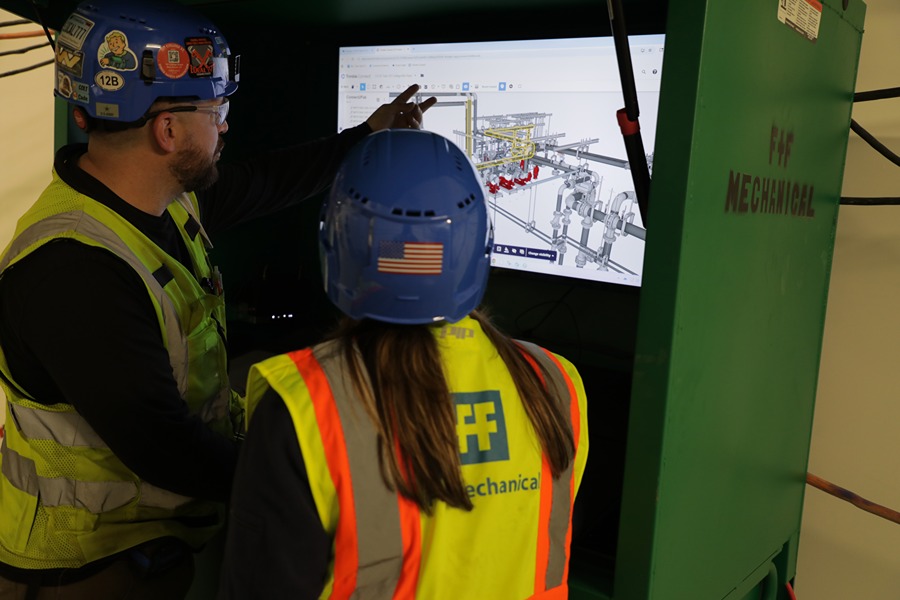
F+F Mechanical links jobsites, the office and fabrication shops in real time through connected Trimble solutions such as Trimble Connect and ProjectSight. For complex MEP installations, the company depends on that connected Trimble ecosystem to sustain a continuous flow of information: shared data and real-time feedback tie estimating, project management, modeling, fabrication and field operations together, so issues are resolved before fabrication starts. Installation accuracy improves, manual measurements and rework fall, and cross-department visibility and collaboration have produced a 10–30% increase in overall productivity on projects. Read as a buying decision, the prerequisite is organizational rather than technical — a fabricator that will not expose the shop schedule to the field will not reproduce this range.
A survey workflow rebuilt around live baselines
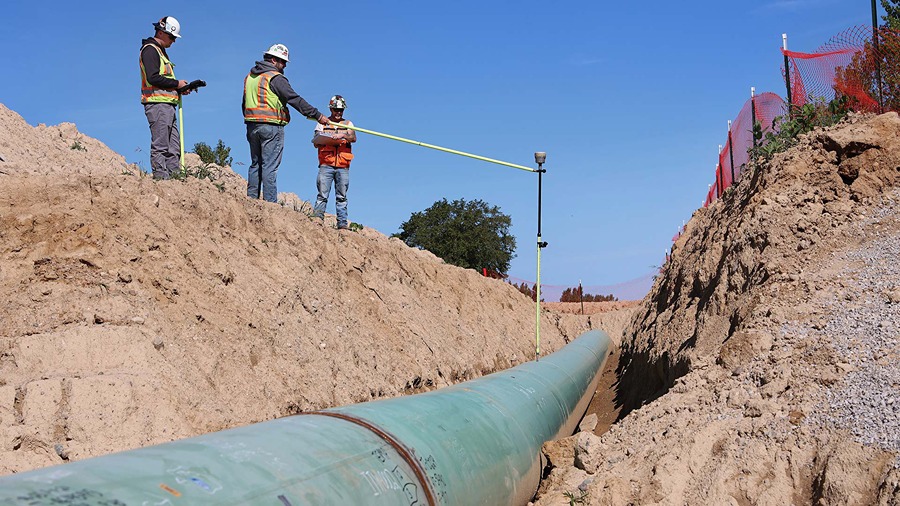
Wade Trim built a connected survey and data management workflow using Trimble Access, Trimble Connect, and a cellular-connected Global Navigation Satellite System base-station network. Deployed on a $550 million, 55-mile natural gas pipeline, it joined field data, current construction plans, design revisions and office processing; survey crews, engineers and the client's geographic information system team kept working from current information through construction, closeout and restoration. The company finished its surveying scope 10% under budget, improved data management efficiency by 25% and reduced survey rework by 20%. For engineering firms the transferable insight is that connectivity infrastructure — not the rover fleet — carried the gain, and that a client GIS team willing to share the same live layer is a condition of entry.
A 3/16-inch finding that cancelled a schedule threat
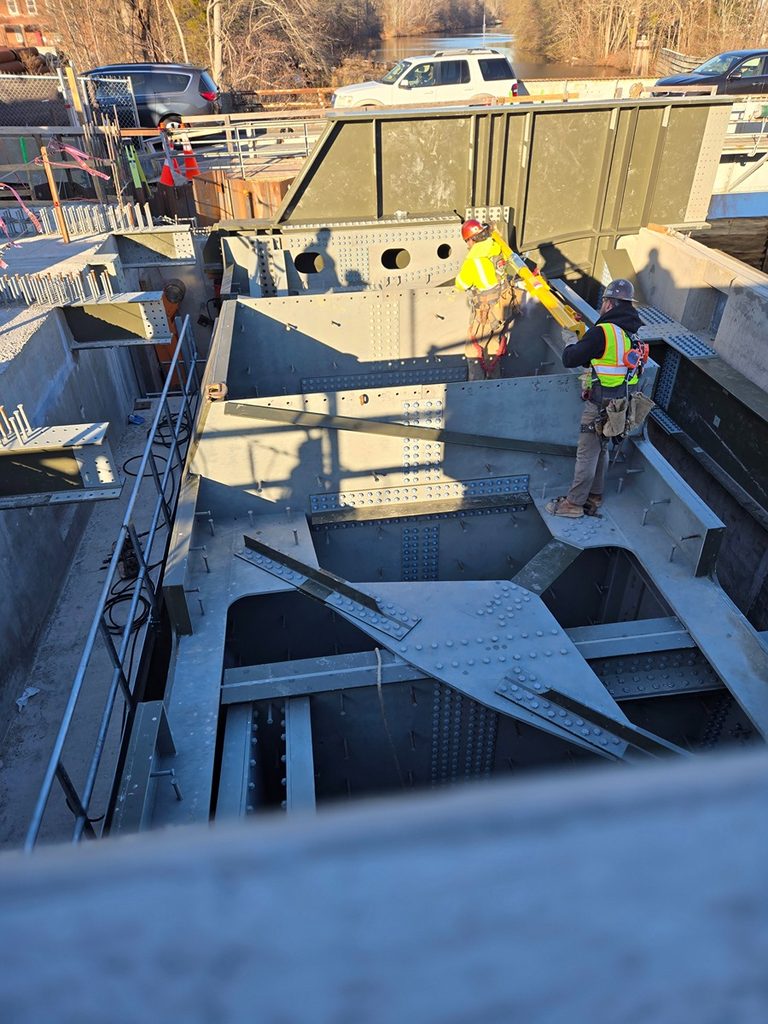
Land to Sand Site Services avoided a major bridge-project delay by applying Trimble scanning and 3D modeling on site and at the fabrication shop, which identified a critical component discrepancy. Working at the site of a complex drawbridge replacement in Virginia and at the steel fabrication site in Canada, the Land to Sand team caught a 3/16-inch dimensional discrepancy in components during fabrication. Because the issue surfaced early, supporting concrete geometry could be adjusted before installation, components fit successfully, and rework plus an estimated eight-month delay were avoided. The practice of capturing reality early, comparing it with design intent, communicating the difference and acting while correction remains manageable has now been scaled to additional projects — the pattern worth copying even when a given scan finds nothing.
The back office as an untapped productivity frontier
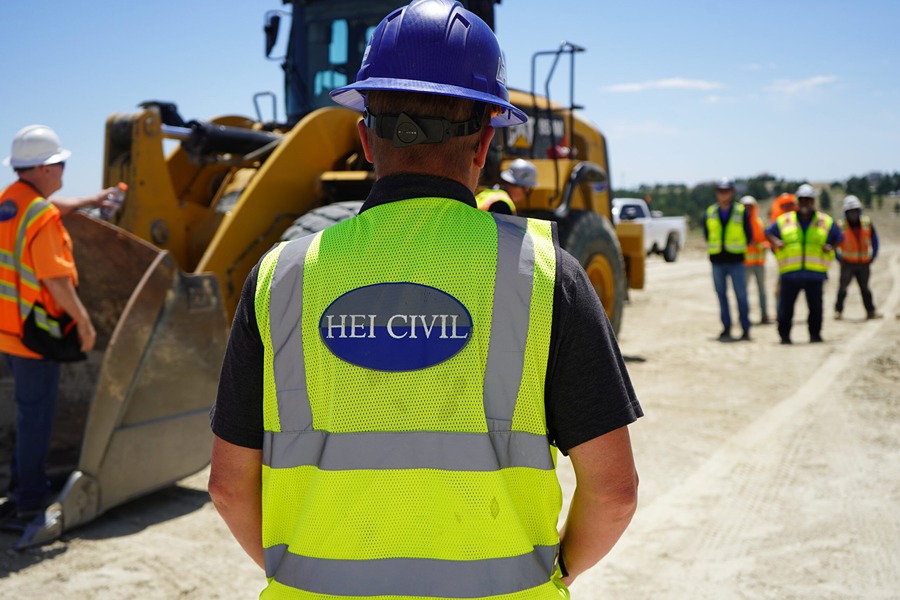
HEI Civil produced transformational improvements in human resource and subcontractor management processes by using Trimble financial management systems. Ashley Rivera, HEI Civil data and automation director, designed and built an integrated applicant tracking system with Trimble Spectrum to streamline hiring and onboarding across four entities and three states. That change cut processing time from 1–2 hours to 15–30 minutes per employee, saving approximately 1,125 staff hours and $35,000 in labor costs each year. Trimble financial management capabilities also let HEI automate its vendor lien release workflow: processing time fell from 16 hours to 2 hours per lien (88%), and 14 hours of skilled accounting time per lien can now be reassigned to more valuable work. For industrial operators this is the cheapest entry point in the set — no scanning crews, no machine control — and the one most often left out of technology roadmaps.
Two educator tracks, two different payback clocks
Abiola Akanmu, a Virginia Tech construction professor, uses the Trimble XR10 with HoloLens to create an immersive virtual construction-site experience that introduces K–12 students to technology-enabled construction careers. Through simulated scenarios and interactive demonstrations with laser scanners and drones, students meet modern construction careers virtually; since 2023 the initiative has reached thousands of students across multiple regional outreach events. Since 2023, in other words, the return has been pipeline volume rather than immediate skills, which suits employers betting on apprenticeship intake three to five years out.
Akanmu's higher-education work runs on a shorter clock. As a Virginia Tech professor, she also brings the Trimble X7 scanner, RealWorks and Trimble XR10 HoloLens into her construction curriculum to train students in real-world data capture and analysis; in hands-on coursework students process point-cloud data for volume calculations and site condition assessments while using mixed reality to explore virtual jobsite operations. That connected learning experience links classroom instruction with industry research and university outreach, including scanning the historic Norfolk & Western 611 locomotive to investigate clearance concerns.
Sharing the higher-education honor, Jon Elliott, an associate professor at Colorado State University, uses Trimble X7 and X9 laser scanners, FieldLink, RealWorks and SketchUp to teach students practical Scan-to-BIM workflows. In hands-on graduate and undergraduate coursework, students capture jobsite data, verify field installations and perform quality control in direct collaboration with industry partners, connecting advanced geospatial technology with real-world problem-solving so students can deliver industry-ready construction solutions. Compared with the K-12 track, this is the pattern a firm can feed directly into VDC and field-engineer hiring.
Four misreadings that make these results misleading
- Treating a range as a guarantee. The 10–30% productivity band is reported for one fabricator's project mix, not a catalogue specification; a two-shift sheet-metal shop and a multi-state MEP prime start from different baselines.
- Buying hardware before data ownership. Both field patterns succeeded because models, plans and revisions flowed to one place. Scanners and rovers bought into departmental silos reproduce the interoperability cost NIST estimated at about $15.8 billion a year for the capital facilities sector.
- Counting avoided rework as hard savings only. The Land to Sand case is a schedule-risk result: an estimated eight-month delay avoided on a drawbridge replacement matters more to liquidated damages and crew remobilization than to the 0.38 percent average precompletion rework figure reported in ASCE-summarized research.
- Reading the educator awards as philanthropy. With ABC projecting roughly 349,000 net new workers needed in 2026, faculty running scan-to-BIM and mixed-reality curricula are shortening the ramp time on entry-level hires — a workforce cost control, not a community event.
How to sequence a 90-day pilot that yields comparable numbers
- Pick one handoff, not one product. Baseline the hours lost between estimating, the shop and the field on a single active package, then define the metric you will re-measure at day 90.
- Instrument the administrative twin. Onboard a lien release, sub payout or applicant-tracking process in parallel; the HEI Civil pattern shows per-transaction hours are the easiest auditable evidence to produce.
- Set a tolerance discipline before capture. Specify who compares scanned reality against design intent, at what dimensional threshold, and how correction is raised while it is still cheap — the operative lesson behind the 3/16-inch finding.
- Connect the client's systems early. Confirm the owner or GIS team can consume live layers; a cellular-connected base network only pays if counterparties work from the same current information.
- Convert recognition into training. If a vendor program offers conference access as an award or credit — as it does here, with Trimble Dimensions, November 9-11, 2026 in Las Vegas — budget the staff hours to attend, since the session catalogue is where implementation failures get diagnosed.
- Close the loop with schools. Hire from programs teaching Scan-to-BIM and mixed-reality jobsite workflows rather than paying a full quarter of remediation training.
FAQ: what operations and capital committees ask first
Are these award numbers independent?
No. They are participant-reported figures screened by a judging panel that included past award-winning companies, Trimble judges and trade media journalists. Use them as directional case data, and validate against your own baselines.
Which pattern pays back fastest for a mid-size firm?
The administrative pattern. Automating hiring, onboarding and lien release required no field crews — HEI Civil's per-employee processing fell from 1–2 hours to 15–30 minutes, worth roughly 1,125 staff hours and $35,000 a year, and each lien dropped from 16 hours to 2 hours.
Why add an educator category to a technology award at all?
Because installed software is useless without people who can operate it. With about one in five U.S. construction workers at or near retirement age, the K-12 and higher-education tracks address the constraint that limits utilization of everything else on this list.
Does the Trimble ecosystem transfer to non-Trimble estates?
The mechanism transfers even if the products do not: a single shared model, real-time feedback between shop and field, defined tolerance thresholds, and one live data layer per stakeholder. Program details sit at trimble.com if a buyer wants the original case write-ups.
Reference sources
- Federal Reserve Bank of Richmond, Economic Brief (2025), "Five Decades of Decline: U.S. Construction Sector Productivity" — https://www.richmondfed.org/publications/research/economic_brief/2025/eb_25-31
- Goldman Sachs Insights, "Why Has Productivity in the US Construction Industry Stagnated" — https://www.goldmansachs.com/insights/articles/why-has-productivity-in-the-us-construction-industry-stagnated
- NIST GCR 04-867, "Cost Analysis of Inadequate Interoperability in the U.S. Capital Facilities Industry" — https://www.nist.gov/publications/cost-analysis-inadequate-interoperability-us-capital-facilities-industry
- ASCE Civil Engineering Source (Jan. 22, 2026), "How much does field rework in construction actually cost?" — https://www.asce.org/publications-and-news/civil-engineering-source/article/2026-01-22/how-much-does-field-rework-in-construction-actually-cost
- Associated Builders and Contractors workforce outlook, via ABC Carolinas — https://abccarolinas.org/construction-industry-labor-shortage-data-drivers-and-strategic-responses/
- Trimble announcement of the 2026 Construction Innovation Awards — https://news.trimble.com/2026-11-04-Trimble-Announces-Winners-of-2026-Construction-Innovation-Awards
- Trimble Dimensions 2026 event overview — https://www.trimble.com/en/our-company/events/dimensions/overview
This comparative read was prepared for WorldIndustrialWeekly's General desk; industrial technology tips and corrections can be sent to news@industrialweekly.com.